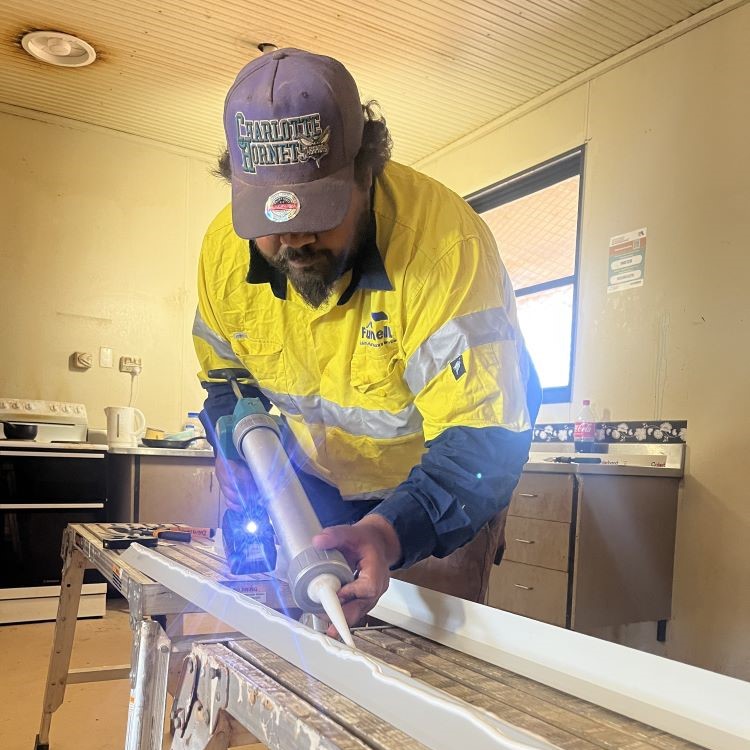
A housing retrofit project launched in the APY Lands in 2023 has significantly improved indoor temperatures for some residents who live in one of the harshest climates in Australia.
The project, run by Adelaide University, the South Australian Government and industry partners, focused on relatively simple upgrades to existing homes in the remote small township of Indulkana, an Aboriginal community in the Aṉangu Pitjantjatjara Yankunytjatjara (APY) Lands in South Australia.
The final report, published in June 2026, provides findings that the retrofitted houses are warmer in winter, cooler in summer and more energy efficient, which can help reduce pressure on government-funded electricity supplies.
The APY Lands Energy Efficiency Retrofit Pilot, part of the national RACE for 2030 Cooperative Research Centre, was developed in response to concerns from residents and government agencies about the high energy demands and poor thermal comfort of housing in Indulkana.
While the APY Lands are often associated with extreme summer heat, researchers found that winter was also a major challenge for many households.
Before the project began, more than half of residents interviewed said their homes were always cold during winter. Many relied on electric heaters for long periods and some even used ovens and stovetops for warmth.
"People were telling us they felt cold inside their homes even though the houses had been designed to perform well," said Adelaide University researcher Professor Ke Xing, from the School of Electrical and Mechanical Engineering.
"We wanted to understand why that was happening and identify practical solutions that could improve thermal comfort while reducing energy demand for heating and cooling."
Building assessments revealed significant impacts caused by air leaks, gaps in the building envelope, and thermal bridging, where heat escapes through framing and other structural elements.
The project team worked closely with residents, community leaders and local tradespeople to design, test and implement upgrade solutions.
Six homes received upgrades ranging from gap sealing and improved ceiling insulation through to additional external wall insulation, while another six homes were monitored for comparison.
The difference was immediately noticeable, Prof Xing said.
“After the retrofits, residents reported feeling warmer even without heaters running and said they needed heating for much shorter periods. In summer, many households reported using cooling systems for only a few hours a day rather than continuously.”
Monitoring and testing confirmed the changes weren't just perceptions.
The retrofitted homes required significantly less electricity during cold weather, with energy savings estimated at around 20 kilowatt-hours per day on colder days.
The upgrades also reduced air leakage by an average of 53%, helping homes maintain more stable indoor temperatures despite the harsh desert climate.
The benefits extend well beyond thermal performance and liveability.
Researchers estimate even basic retrofit treatments could save households around $400 a year in electricity costs. Because electricity supply in the APY Lands is heavily subsidised, government savings are estimated at more than $2600 per household annually.
If implemented across all 411 South Australian Housing Trust homes in the APY Lands, the savings could exceed $1 million every year.
The project also offers environmental benefits, with modelling indicating emissions reductions of more than 10 tonnes of carbon dioxide equivalent per household each year.
Dr Xing said the findings are particularly important as climate change brings more frequent temperature extremes.
"Remote communities are often on the frontline of climate impacts," he said.
"Improving their housing helps people stay comfortable and healthy on Country, while also reducing energy demand and emissions. It's a practical climate adaptation solution that delivers benefits immediately, and for the future."
The project also produced culturally appropriate energy education materials in Pitjantjatjara and English, alongside training resources to help build local skills and support future retrofit programs. These materials are publicly available on the Net Zero Energy Builder website.
The South Australian Housing Trust has already begun rolling out retrofit measures to more homes across the APY Lands, and the findings are influencing the design of future housing projects.
Researchers believe the lessons learned could benefit remote, regional and Indigenous communities across Australia facing similar challenges around energy affordability, housing quality and climate resilience.
"This project shows that small changes can make a big difference," Prof Xing said.
"When people are more comfortable in their homes, the benefits flow through to health, wellbeing, household budgets and community resilience."
With support from the Attorney General’s Department (Aboriginal Affairs and Reconciliation), Adelaide University researchers partnered with the SA Department for Energy and Mining, the SA Housing Trust, Powertech Energy, ATTMA, ICANZ, Kingspan, Sika Australia, Pointsbuild, Efficiency Matrix, Deep Space, TAFESA and community focused organisations such as Healthabitat and Nganampa Health Council. They also worked closely with the Iwantja (Indulkana) Community Council and residents, including Aṉangu Energy Education Workers supported by MoneyMob Talkabout.