Culturally and Linguistically Responsive Early Childhood Pedagogies

Culturally and Linguistically Responsive Early Childhood Pedagogies

About this project

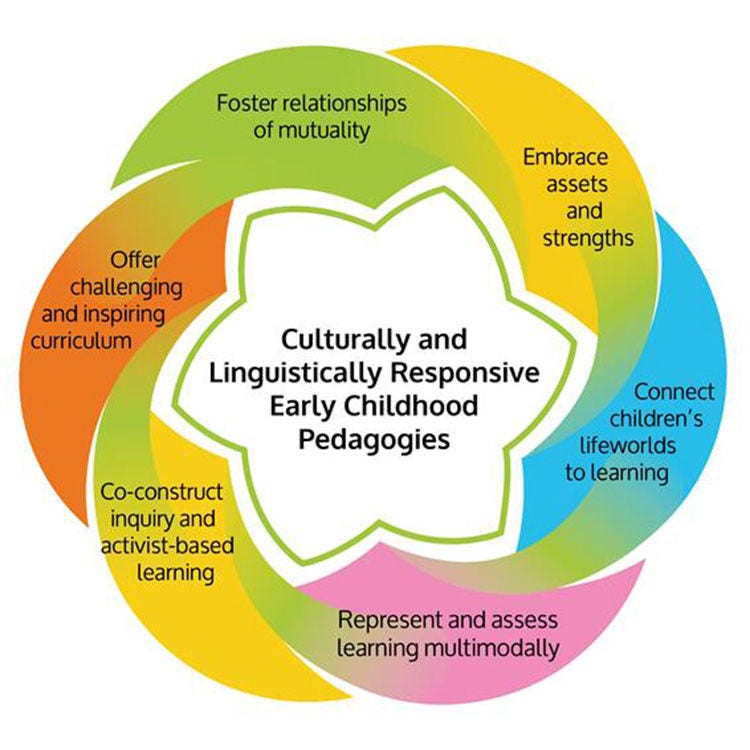
The Culturally and Linguistically Responsive Early Childhood Pedagogies research project aims to co-investigate early childhood education practices that support meaningful learning and a strong sense of belonging for all children, families and educators. This project recognises the pivotal role of early childhood educators and leaders in translating policy into meaningful practice, and addresses the gap between policy and practice by using a co-design approach. As a result, the project outcomes include both research outputs and practical resources, including The Australian Framework for Culturally and Linguistically Responsive Pedagogies.

This project is funded by the Lillian de Lissa Trust and five industry partners across South Australia and New South Wales. Led by Adelaide University in partnership with Western Sydney University, the research brings together educators, site leaders, academics, Elders and visiting scholars to co-design responsive and inclusive practices grounded in everyday early childhood contexts.  

Background

The early years of a child’s life are important not only to their future learning, but also to their developing identities and sense of belonging to a broader community. We know that children learn best when they feel a strong sense of identity and belonging within their education and care settings. Culture and language are thus important to childrens identities. We also know that early childhood education (ECE) settings are often rich with cultural and linguistic diversity, however, many ECE professionals have not been adequately supported to develop and implement culturally and linguistically responsive teaching practices. This issue was highlighted in the updated National Australian Early Years Learning Framework (EYLF 2.0) which identified urgent need for early childhood practices to be culturally responsive. Currently however, there remains little guidance on how to achieve this in contextually meaningful and sustaining ways. 

Recognising the pivotal role of early childhood teachers and educators in translating policy into meaningful practice, this project investigates how culturally and linguistically responsive practices are enacted and progressed in early childhood education settings, within South Australia and New South Wales. This project addresses the urgent need for early childhood pedagogies that support educators, to engage with children and families to build upon their rich cultural and linguistic funds of knowledge and identities. Such pedagogies are significant to achieving meaningful learning outcomes that inspire a love of learning in both children and educators, and support strong partnership with families. 

This project builds on previous research within South Australia and New South Wales led by the research team: 

  • An Investigation of the Reimagining of Early Childhood Education in South Australia (Sisson, Whitington and Shin, 2018), 
  • Bringing Culturally Responsive Pedagogies and Reggio Emilia Education Principles into Dialogue (Rigney, Sisson, Hattam and Morrison, 2020). 
  • Early Action for Success 2012-2014 (Arthur and Woodrow, 2018), 
  • Enhancing English Learning: Building on Linguistic and Cultural Repertoires in School Settings (D’warte, 2018) 
  • Toward an Australian Culturally Responsive Pedagogy, Australian Research Council Discovery Project (IN170100017) (Rigney & Hattam, 2016-2019)

These projects have created a strong foundation from which to build culturally and linguistically responsive early childhood pedagogies across both jurisdictions. This project aligns with:

  • the South Australian Early Learning Strategy 2021-2031 (Government of South Australia, 2021), which aims to build research partnerships to inform evidence-based culturally responsive practices and strengthen partnerships with families.
  • the NSW Department of Education’s Multicultural Plan 2024-2027 (NSW Department of Education, 2025) which strives to enhance evidence-based pedagogies and improve the participation of children and families from culturally, linguistically and religiously diverse backgrounds in all aspects of school life. 
  • ACECQA’s (2021) national workforce strategy, which acknowledges the urgent need for ECE professionals to have improved access to ongoing professional learning. 

Project Partners

Lillian de Lissa Trust logo
Western Sydney University logo
NSW Education logo
Catholic Education South Australia logo
Gowrie South Australia logo
KU Children's Services logo
Ngutu College logo

Objective and design

Objectives

  • Develop a collaborative professional learning community across two states, focused on co-designing culturally and linguistically responsive early childhood practice. 
  • Provide mentoring to support sites in facilitating two whole-year action research cycles, focused on engaging with culturally and linguistically responsive pedagogies. 
  • Support ECE leaders in developing a whole-of-site approach that sustains culturally and linguistically responsive early childhood pedagogies. 
  • Develop project resources that will be publicly available to inform teacher education and professional learning. 

Design

This project uses a co-design approach to develop a bespoke professional learning community. This community includes early childhood educators, leaders, academics, local Elders and visiting experts from the field who discuss strategies and challenges for co-constructing meaningful culturally and linguistically responsive practices for all children, families and staff. As part of the co-design approach, educators and leaders engage in critical action research to trial theoretically-informed culturally and linguistically responsive practices. Qualitative methods such as interviews and observations are used to explore the experiences of educators, leaders, children, and families. 

Five research questions underpin the project:

  • What practices and policies serve as barriers to the inclusion of culturally and linguistically diverse children and families in ECE settings?
  • How are ECE practices re-imagined in culturally and linguistically meaningful ways?
  • How do ECE professionals create atmospheres of welcoming for all families?
  • How do ECE leaders sustain and grow the capacity of staff to implement culturally and linguistically meaningful pedagogies across sites and organisations?
  • What are the experiences of children, families, and ECE professionals when pedagogies are re-imagined to be culturally and linguistically meaningful?


Publications, conferences and resources


Barnes, J., & D’warte, J. (December 2024) Exploring Early Years Educators’ perceptions of Culturally and Linguistically Responsive Pedagogies through the lens of Funds of Knowledge and Funds of Identity. Australian Association for Research in Education Conference, Sydney, NSW.  

Sisson, J., Whitington, V., Woodrow, C., & Morrison A. (December 2024) Lowering Atmospheric Walls to Family Partnerships. Australian Association for Research in Education Conference, Sydney, NSW. 

Whitington, V., Sisson, J.H. & Woodrow C. (December 2024) Critical action research as a professional learning tool: a case study across four early years education settings. Australian Association for Research in Education Conference, Sydney, NSW. 

Staples, K. & Woodrow, C. (December 2024) Scaffolding Family Relationships: A Continuum of Practice. ‘Education in a Changing World’ Australian Association for Research in Education Conference, Sydney, NSW.  

Sisson, JH, (2024) Responsive and Meaningful Engagement: Re-flection. Early Childhood Organisation AGM. 

Iovino, M*., & Whitington, V., (July, 2024) Languages as a learning asset in a preschool context” Australian Literacy Educators Association Conference, Adelaide. 

Whitington, V., Sisson, J.H. & Woodrow C. (September 2024) Critical action research as a professional learning tool: a case study across three early years education settings. European Early Childhood Education Research Association, Brighton, UK 

Whitington, V, & Sisson, JH (2023, Aug) Culturally and Linguistically Responsive Pedagogies in Early Childhood Education. European Early Childhood Education Research Association, Portugal. 

Sisson, JH, Vittoria B*, Woodrow, C., & Martino, J.* (2023, Oct). Culturally and Linguistically Responsive Partnerships with Families. Early Childhood Australia National Conference, Adelaide, Australia. 

Sisson, JH, Woodrow, C, & D’warte, J. (2022, November) Methods for Engaging with Funds of Knowledge. Symposium: Early Childhood Pedagogies for Social and Environmental Justice. Australian Association for Research in Education. Transforming the Future of Education: The role of research, Adelaide, South Australia.

*denotes practicing teacher-researcher

Articles summaries of key relevant literature on culturally and linguistically responsive pedagogies explored within the professional learning communities. 

Contact information

If you would like to become involved or learn more about this project please contact us

Project Lead: Associate Professor Jamie Sisson