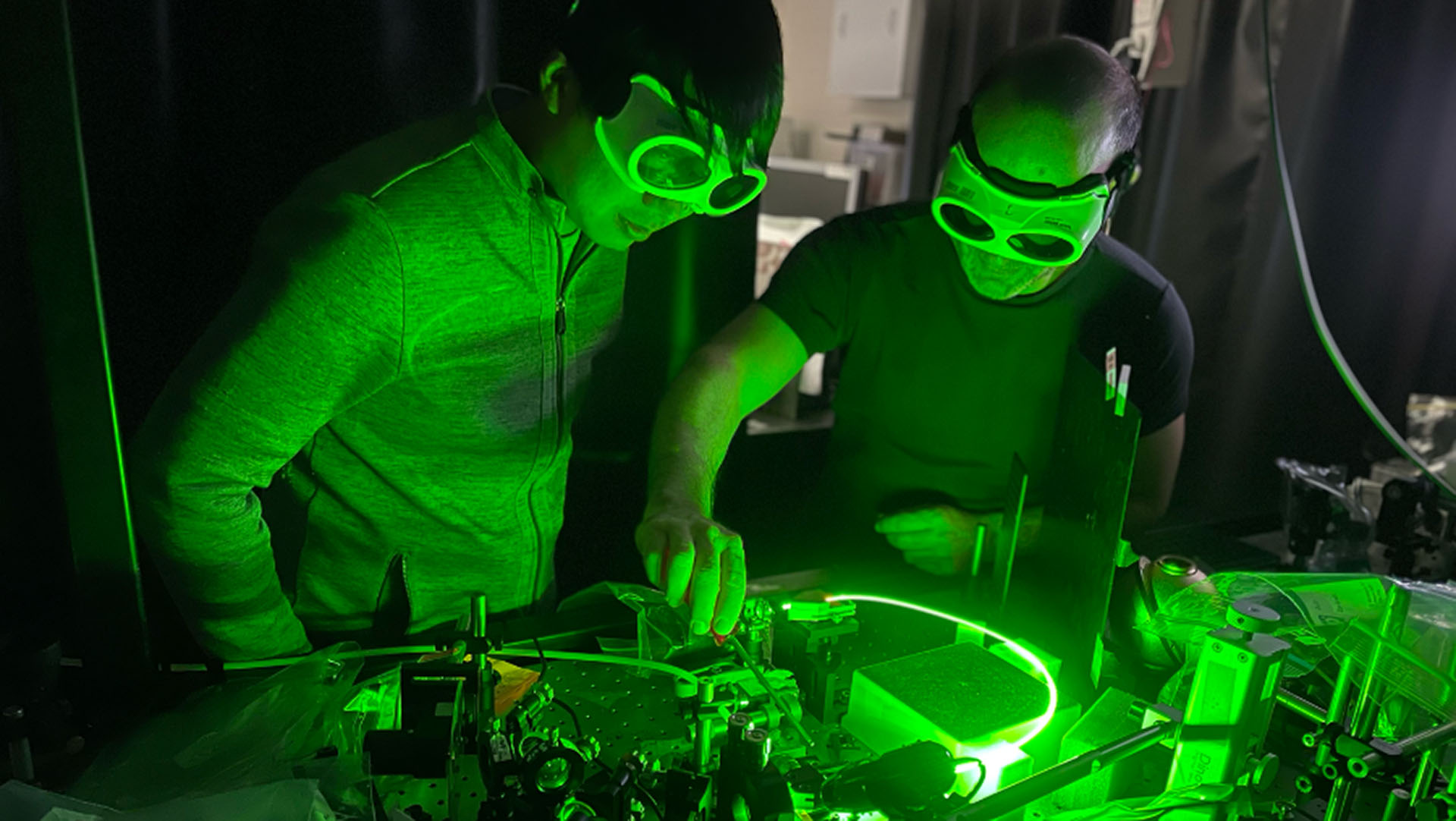
Laser Capability Hub

Laser Capability Hub

Adelaide University has been developing extensive capabilities in directed energy over decades

Advanced Laser Technologies underpin critical capabilities across defence, communications, manufacturing, health, sensing, and space. Adelaide University brings together world-leading expertise spanning semiconductor, chip-scale, fibre, and high-power laser technologies. 

Our mission is to translate foundational photonics research into deployable laser systems. Our purpose is to establish an end-to-end sovereign laser ecosystem spanning semiconductor diode lasers, photonic chip and integrated lasers, specialty fibre and fibre laser systems, and high-power and directed energy laser platforms. 

Globally, sovereign capability in high-performance laser systems, from semiconductor devices through to scalable high-power architectures, is increasingly recognised as strategically essential. However, Australia currently faces a gap in end-to-end laser development across these interconnected domains. 

The establishment of this capability delivers significant national benefits, including sovereign development of directed energy systems and sub-systems, and reduced exposure to supply chain risks such as the fragile global market for diode laser systems. It enables innovative solutions for power and thermal management, supported by immediate delivery capacity through more than 20 experienced defence researchers, academic leaders, and a dedicated project manager. This is underpinned by specialised laser laboratories representing a combined investment of $20M. 

Adelaide University hosts a unique concentration of internationally recognised researchers across the full laser technology stack. The Laser Capability Hub (LCH) formalises this strength into a nationally visible capability, supporting defence, industry, and health priorities. 

Lightening icon

Directed energy applications

Satellite dish icon

Free-space and space-based laser communications

Gauge measure icon

Advanced sensing and LiDAR

Stethoscope icon

Medical and health technologies

Crosshair target bullseye icon

Precision manufacturing and defence systems

Explore Laser Capability Hub

Semiconductor & Diode Laser Sources 

  • High-efficiency, high-brightness diode lasers 
  • Quantum and nanoscale emitters 
  • Reliability and thermal management 

Chip-Scale & Integrated Laser Systems 

  • Photonic integrated circuit (PIC) lasers 
  • Hybrid semiconductor–silica platforms 
  • Compact frequency-stable sources 

Fibre & Specialty Glass Laser Platforms 

  • Novel glass compositions for high-power handling 
  • Rare-earth doped fibre lasers 
  • Structured and microstructured fibre systems 
  • Fibre-based sensing and communications platforms 

High-Power & Directed Energy Systems 

  • Power scaling architectures
  • Beam combining techniques 
  • Thermal and optical stability
  • Defence-relevant directed energy demonstrators 

Prof Heike Ebendorff-Heidepriem has expertise in glass science. Heike has more than 20 years' experience in the science and technology of optical glass and fibers for diverse applications including lasers and other novel light sources. She currently supervises 14 Higher Degree Research students. 

Professor Glenn Solomon is the inaugural Hicks Chair of Quantum Materials. His research is at the interface of condensed matter physics and quantum optics where he explores the interaction of light with semiconductor and superconducting materials, and utilize these interactions to develop devices, and proof-of-principle systems. Research topics include epitaxial crystal growth of semiconductor nanostructures, coupling them to optical cavities and waveguides leading to the development of semiconductor diode lasers and quantum light sources 

Prof David Ottaway is an expert in laser development with more than 25 years’ experience in developing lasers for applications ranging from LIDAR to gravitational wave detection (LIGO). 

Professor Craig Smith is the SmartSat Mike Miller Professorial Chair in Telecommunications.  Professor Smith has worked as a Research Scientist, R&D Manager, Corporate Executive, CTO and CEO across multiple disciplines, including astronomy, space surveillance technologies, astrodynamics and the defence industry. With 35 years of experience in the space and defence industries, he was the CTO at Electro Optic Systems (EOS) and CEO of EOS’s Space and Defence Systems operations. 

Prof David Lancaster is the EOS Chair of Laser Physics and the Director of the Laser Physics and Photonics Devices Laboratories (LPPDL) group. His research is in the broad field of experimental laser physics, photonic sensors, and ultrafast laser fabrication.  His current research areas include advanced fibre and waveguide lasers; photonic manufacturing techniques; and advanced remote sensors for defence and the mining sectors.  

Dr Stephen Warren-Smith is an ARC Future Fellow. His research focuses on exploiting unique optical effects within speciality optical fibres to solve sensing problems for industry. His background includes experience in soft-glass and silica microstructured fibre fabrication, fluorescence sensing modelling, surface functionalisation of optical fibres, optical fibre sensor development, fibre Bragg gratings, and ultra-high temperature sensing. 

Contact Laser Capability Hub

Location

Location
Laser Capability Hub
Level 1, The Braggs Building, City Campus East
Adelaide University, Adelaide SA 5005

Email

Email: sebastien.hebert@adelaide.edu.au

Contact us

Institute for Photonics and Advanced Sensing

Location

Location
Institute for Photonics and Advanced Sensing
Adelaide University
Level 1, The Braggs Building, City Campus East, Adelaide SA 5000

Telephone

Phone: +61 8 8313 9211

Email

Email: ipasadelaide@adelaide.edu.au