Photonic Integrated Circuits

Photonic Integrated Circuits

Bringing precision measurement out of the laboratory

Reducing the size, weight and power of the precision measurement systems is crucial to make such systems robust and portable, suitable for operation outside of well-maintained laboratory conditions. 

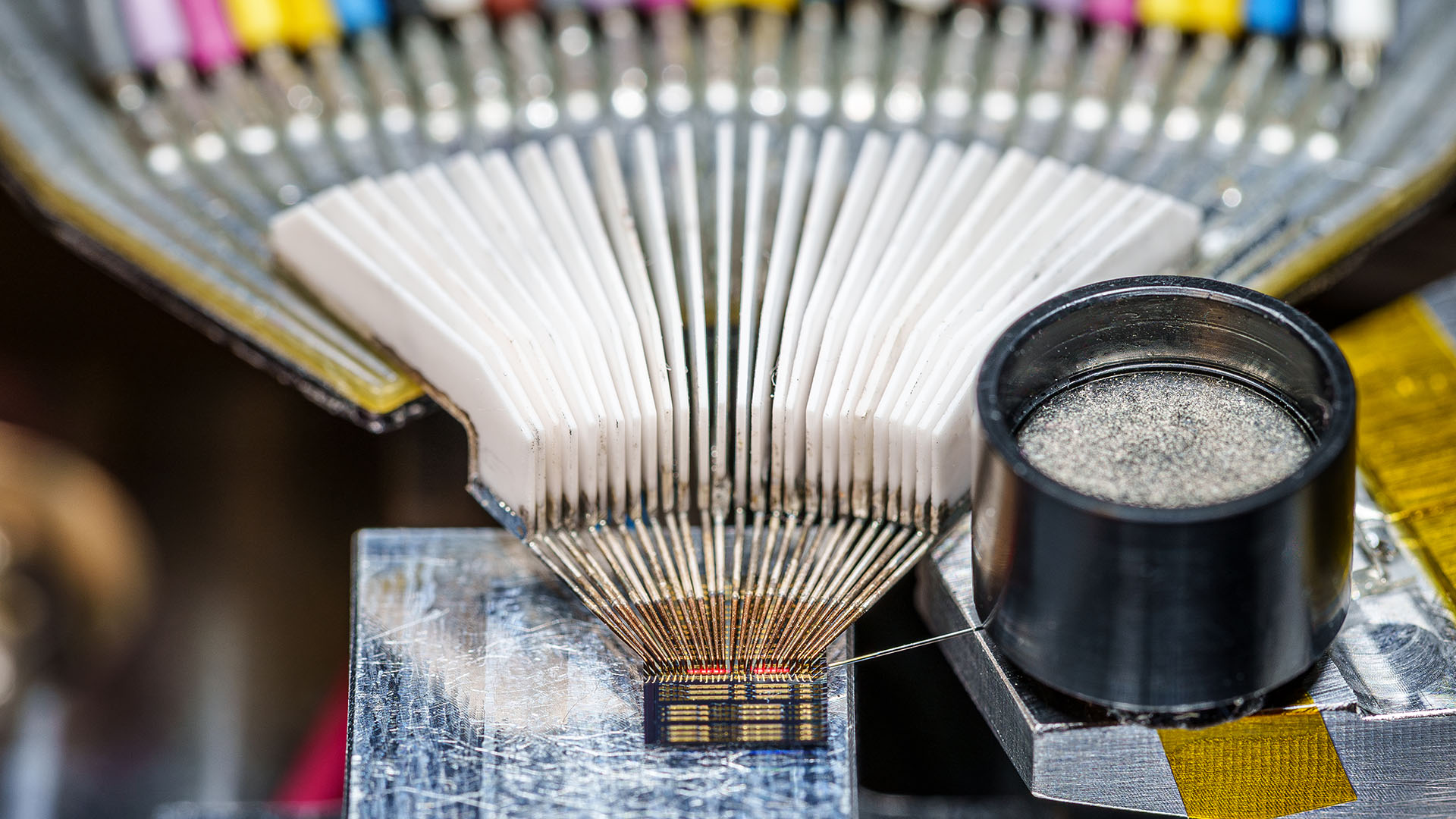
To achieve this, the Photonic Integrated Circuit research group explores micro-nano fabricated optical circuits to integrate tens to hundreds of previously individual optical components, all on a single semiconductor circuit chip. These chip-scale precision measurement systems have the potential to enable robust and portable systems for remote environmental monitoring and enhance the capabilities of next-generation drones and satellites. 

Network ideas map icon

Photonic integrated circuits enabled precision measurement systems

Atom icon

Nonlinear photonic integrated circuits

Lightbulb icon

Narrow linewidth integrated photonic light sources

Antenna radio signal icon

Acousto-optic waveguides

Molecule structure cells icon

Heterogenous integration of functional photonic materials

Explore Photonic Integrated Circuits


Twenty years ago, precision timing saw a paradigm shift in clock technology by using optical atomic transitions rather than conventional microwave transitions. Optical atomic transitions intrinsically deliver a huge uplift in potential performance. However, these extreme clocks fill an entire lab and require complex and delicate electronic and optical systems.

The Precision Measurement Group that we are strongly collaborating with has recently discovered that a two-photon optical transition in Rubidium vapour can be used to achieve a relatively simple and compact clock while maintaining performance matching the best space-based clocks used for global positioning systems. However, these clocks are still the size of a suitcase. This project aims will integrate narrow linewidth light sources, microcombs and other photonic elements of an optical atomic clock onto a single chip, while delivering unprecedented stability and timing accuracy. This will enable tactical inertial navigation systems with the size, weight, and price of consumer electronics.

This Australian Research Council (ARC) funded project aims to create a new class of integrated microwave information processors on a single optical chip. Using electro-acoustic coupling in semiconductors we expect to reduce optical power requirements, enabling the emergence of practically deployable processors using ordinary telecom lasers.

The expected project outcomes are inexpensive, compact, stable, and energy-efficient microwave photonic processors, which have the potential to create a multitude of opportunities for commercial development in the fields of defence, information, security, autonomous vehicles, sensing, and ultra-high bandwidth mobile communications.

LiDAR and hyperspectral imaging both face key limitations that hinder broader use. LiDAR systems can be expensive, bulky, and sensitive to weather conditions, with constraints on speed and power efficiency. Hyperspectral imaging captures rich spectral data but requires complex, costly hardware, has slower acquisition rates, and produces large datasets that are challenging to process. Both technologies also struggle with miniaturization and real-time deployment.

Microcombs offer a compact, efficient solution to these challenges. By generating many stable, evenly spaced wavelengths on a single chip, they enable faster, more precise LiDAR measurements while reducing size and power use. For hyperspectral imaging, microcombs allow rapid, parallel spectral capture without bulky components, improving speed, simplifying system design, and supporting scalable, integrated devices.

Research lead

A/Prof Andy Boes
Postdocs
  • Dr Lisa Haerteis  
  • Dr Dorian Oser  
  • Dr Lothar RatschbacherDr Van Thuy Hoang  
  • Mr Hannes Griesser 

The research group is supported through a combination of funding sources, including Adelaide University, the ARC Centre of Excellence in Optical Microcombs for Breakthrough Science (ARC COMBS), ARC Training Centre for Current & Emergent Quantum Technologies (ARC QuTech), Defence’s ASCA EDT program, and the Defence Trailblazer initiative. 

This research group is part of the aPNT Research Hub.

Contact Photonic Integrated Circuits

Location

Location
Photonic Integrated Circuits
Level 1, The Braggs Building, City Campus East,
Adelaide University, SA 5005

Email

Email: andy.boes@adelaide.edu.au

Contact us

Institute for Photonics and Advanced Sensing

Location

Location
Institute for Photonics and Advanced Sensing
Adelaide University
Level 1, The Braggs Building, City Campus East, Adelaide SA 5000

Telephone

Phone: +61 8 8313 9211

Email

Email: ipasadelaide@adelaide.edu.au