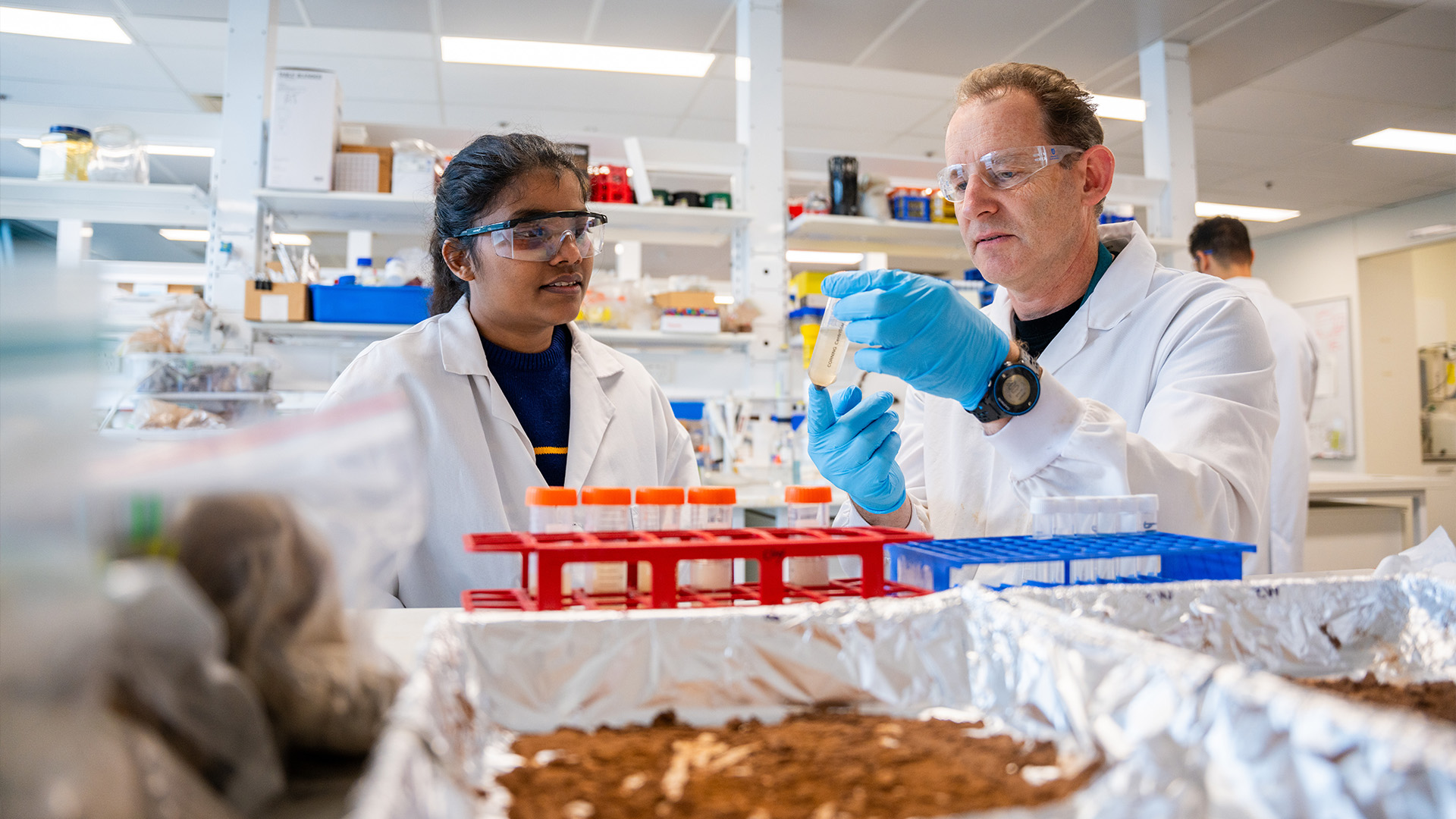
Researchers at Adelaide University are developing new, innovative ways to fight back against hard-to-eradicate chemicals that are degrading our health and ecosystems.
Perfluorinated substances (PFAS) are polluting our food, land and water systems, leading to serious health problems for people and animals. They’ve earned the nickname ‘forever chemicals’ because they resist breakdown, remaining in the environment for decades. Today, most people have detectable amounts of PFAS in their blood, with the potential to accumulate, increase cancer risks and cause immune, hormonal and developmental disruptions.
With global concern growing, Adelaide University researchers are exploring this systemic issue across the full spectrum – from exposure to clean‑up – and helping turn one of today’s most intractable environmental and health threats into a solvable problem. They’re improving how PFAS exposure is measured, treating contaminated soil and water, investigating impacts on fertility – and advancing innovations to break down and eliminate them.
PFAS are widely used in consumer and industrial products – such as non-stick cookware and waterproof materials – due to their unique ability to repel oil, water and stains. This quality also made them a key ingredient in firefighting foam. The now-restricted PFAS foams, along with the disposal of PFAS-contaminated waste in landfills and the application of biosolid (sewage sludge) to land, have created significant soil contamination in Australia. The chemicals are then primed to transfer into livestock, water and crops and enter human food chains.
Dr Shervin Kabiri’s research out of the University’s School of Agriculture, Food and Wine, focuses on understanding how PFAS move through soil – and developing practical solutions to treat them. Her work has helped government regulators, defence agencies and agriculture bodies reduce PFAS concentrations and manage their risks.
“As well as studying PFAS movement, we’re developing practical ways to trap and immobilise them,” says Dr Kabiri. “This is useful because it prevents PFAS from spreading, reducing exposure to people and wildlife.”
Complementing this research is work by Professor Albert Juhasz and his team at the Future Industries Institute, who’ve developed a new in vivo approach to measure how PFAS is absorbed from soil, food and dust in collaboration with the South Australian Health and Medical Research Institute.
“Bioavailability-based evaluations are a much more realistic basis for exposure assessment”, says Professor Juhasz. “Our team’s framework enables more accurate, site‑specific exposure and risk assessment, reducing both under‑ and over‑estimation of harm.”
Their complex investigations incorporate laboratory techniques simulating human digestion, animal studies, water‑leaching tests, plant studies, and earthworm experiments to compare PFAS levels measured in the environment with the amount actually taken up by living systems. The team also partnered with CSIRO to construct a floating wetland to measure the reduction of PFAS in surface water. Crucially, the work showed that the effectiveness of remediation was highly dependent on the type of living system, with simpler systems showing higher treatment efficacy.
In addition to cancer risks and immune issues, it’s well documented that PFAS can disrupt female fertility. Exposure to forever chemicals is associated with delayed puberty, reduced chance of pregnancy, low birth weights, and early menopause. But the mechanisms behind these issues are not yet clear. Team lead Professor Robker, lead researcher Dr Yasmyn Winstanley, and their team from the University’s Robinson Research Institute are working towards answers, investigating how real-world PFAS exposure affects egg quality and embryo development.
Their cutting-edge study, conducted with mice, mimicked humans’ typical PFAS exposure levels via municipal tap water. The results showed that even low-level PFAS exposure can cause cellular damage to oocytes and embryos – and that these effects can persist across generations.
“This study helps explain how PFAS exposure compromises female fertility,” says Professor Robker. “The findings raise important questions about what we currently consider ‘safe’ levels of PFAS in drinking water.”
These chemicals are clearly harmful, but finding effective ways to remove them remains a major challenge. PFAS are notoriously hard to destroy because of their strong carbon-fluorine bonds. Traditional methods like incineration risk releasing toxic by-products and are largely banned in Australia.
Fortunately, Dr Cameron Shearer and his research group in the University’s School of Physics, Chemistry and Earth Sciences, have developed a safer and sustainable alternative. Their method uses light and a photocatalyst powder to break the carbon-fluorine bonds that hold PFAS together.
“The process turns PFAS into harmless fluoride, which can be safely removed from the environment and waterways,” says Dr Shearer.
Not content with a single breakthrough, the team has also built a system to clean polluted water as it flows through it. This modular, continuous‑flow design showcases how we might improve and scale up real-world water treatment.
This is a coordinated response to PFAS out of an ambitious institution. At Adelaide University, ‘forever chemicals’ may not be forever after all.
On the horizon
The Robker and Shearer labs are now working together to understand PFAS exposure and test whether new technologies can prevent damage to fertility and embryo development. The teams aim to progress an innovative new approach to PFAS treatment, alongside a comprehensive dataset on toxicity. The results will provide some of the first insights into PFAS effects at the cellular level, with major implications for living systems of all kinds.
Meanwhile, Professor Juhasz will be further refining exposure assessments by investigating underreached, hard-to-analyse PFAS precursors. And Dr Kabiri’s control technologies are scaling into national guidelines for real‑world remediation programs.
Their work is laying the groundwork for safer communities, healthier ecosystems, and more informed decisions about how Australia – and the world – responds to PFAS into the future.