Aura

The rise of 3D printed guns and ‘sovereign citizens’ create explosive mix

By Mark Douglas

Associate Professor McIntyre
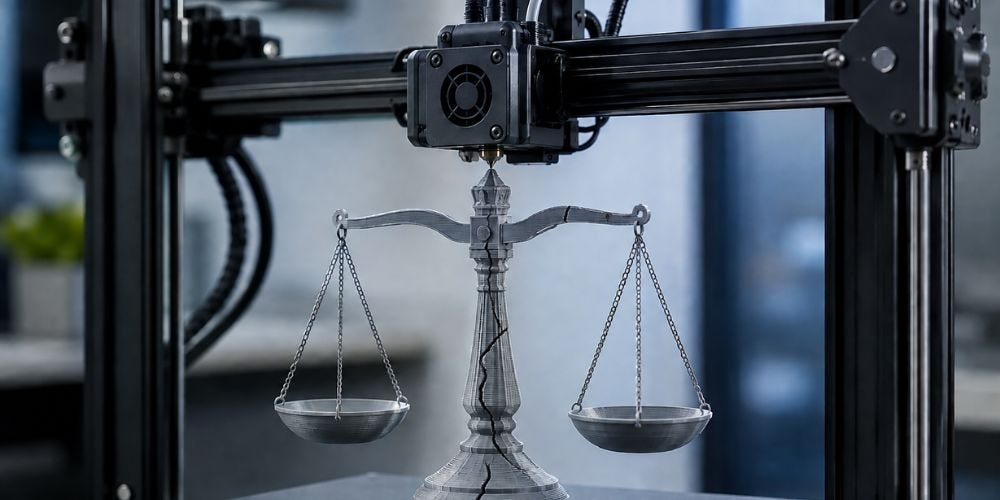
The rise of 3D printed guns and ‘sovereign citizens’ create explosive mix Sovereign citizens, also called pseudolaw adherents, believe ordinary laws do not apply to them. Image: ChatGPT

The creation of home-made 3D printed weapons is on the rise among so-called 'sovereign citizens', a global expert warns.

 "There is an attitude shared among these people which is very anti-authoritarian, often influenced by far-right extremism, and there's a disturbingly long history of violence," Adelaide University Associate Professor Joe McIntyre warns.

"They don't want to pay their tax, they don't want to pay their mortgage or their child support, and once you start thinking that law is optional and discretionary, you start to pick and choose which laws you will obey.

"And that gets us to the violence. I'm going to make a threat because I'm not bound by laws and limits. And suddenly I'm not bound by gun registration, so I'm going to do what I want.

"And so, you get this really dangerous connection between rejection of government authority and law, and this leads to the gun space.

"We have a very large and significant movement that is deliberately placing itself outside of the law and we have technology which allows them to make weapons in their back shed."

Associate Professor McIntyre was awarded his PhD from Cambridge in 2013.

His recent research at Adelaide University includes the publication last year of a definitive research piece on sovereign citizens, co-writing the book Pseudolaw and Sovereign Citizens.

Along with co-author Dr Harry Hobbs from the University of New South Wales, Associate Professor McIntyre hosted the world's first pseudolaw conference in Sydney in 2023, developing a global network of researchers, and he has recently returned from a conference in London.

"We've been studying this in a way that's just not happening anywhere else in the world," he says.

"And that's been really unexpected to find ourselves the global experts in this emerging discipline."

Conspiratorial thinkers more likely to take law into their own hands

Associate Professor McIntyre works with the courts and police to help train them in how to deal with the rise of pseudolaw, and the growing regularity of threats of violence against judges and police.

"You have a rapidly growing global community of people who are really, really good at sharing sophisticated information online across international networks," he says.

"They are really technologically quite savvy. And these people have the opportunity to go into their shed and press play on their 3D printer to produce some very sophisticated weapons, including semi-automatics, in ways that are incredibly difficult to detect and disrupt.

"These guns can be used, they can be melted down and they can disappear. And the people who are attracted to untraceable, self-made weapons are the people who are already putting themselves outside of the law.”

Associate Professor McIntyre says it's almost impossible to legislate against the transference of knowledge which empowers people to program printers to produce these weapons.

"At the end of the day you're talking about a digital file being shared through untraceable spaces in dark corners of the internet.

"There is now a move in some US States to try to tackle the problem by preventing 3D printers from creating these weapons. There's no way yet to know if that will work."

Associate Professor McIntyre says the numbers of sovereign citizens exploded during the COVID-19 era with people feeling powerless, isolated and angry.

“What seems to be a common cause for all of these forms of conspiratorial thinking is a sense of alienation and exclusion. These are driving people towards ideas that promise – and it's a false promise – power and a regaining of control.

"If you're sitting in a shed and you're producing a plastic weapon, you're doing that because you want to feel like you've got some control. I'm not weak anymore.

"The possibility of them getting angry and walking into a court or an office or a council with a firearm is scary.

“It’s authority figures largely who are threatened across all sectors. You could be dealing with somebody’s marital breakdown. You could be dealing with a child custody, you could be dealing with a council dispute about a fence.

"We are seeing some really concerning regularity of this that should be having alarm bells going."

How authorities are dealing with 3D printed firearms

  • It’s illegal to make a 3D-printed firearm in Australia
  • Possession of a digital blueprint to create 3D-printed firearms is now an offence in many states, including South Australia
  • Federal agencies and police forces from across Australia are working together to tackle illicit firearms, including 3D printed weapons

Other dimensions to 3D printed weapons

  • Despite advances in 3D printing technology, 3D-printed firearms lack manufacturing safety standards so are highly dangerous to the user
  • Homemade firearms still rely on traditional, commercially acquired ammunition, which is tightly regulated in Australia
  • 3D-printed guns are not as untraceable as many people think.

Sovereign citizens (pseudolaw adherents)

  • Pseudolaw adherents are individuals who believe ordinary laws do not apply to them. Built on a conspiratorial world view, adherents deploy their own interpretation of law to refuse to register their vehicles, obtain drivers licences, pay council rates, or recognise the authority of courts.
  • The impact of pseudolaw adherents is broad and diffuse. Despite not recognising the authority of courts or government, they frequently file voluminous documents with state actors, waste resources, increase costs on themselves and others, and erode confidence in the administration of justice and governance.
  • The risk of violence cannot be dismissed. While most adherents are not violent, the narrative that underlies the ideology holds that governments are illegitimate, seeking to enslave citizens. This ideology has led individuals into confrontation and violence.

Source: Pseudolaw and sovereign citizens: An overview and key issues

Republish this article

Republish our articles for free, online or in print, under Creative Commons licence. See our republishing guidelines for details.