
An Adelaide mother has shared her heartbreaking path to parenthood in the hope of raising more money for fertility and pregnancy research.
Ella and her husband were in their early thirties when they decided to start trying for a baby. They had no idea at the time that it would take eight long years and more than $60,000 in fertility treatments until their family was complete.
The first four years of their fertility journey were consumed by tests and treatments including ovulation inductions and intrauterine inseminations, followed by two rounds of IVF.
“The hardest part of my fertility journey were the losses. The low lows were definitely the hardest part, just the emotional burden that you carry,” Ella said.
“I felt like it’s me again. I don’t have good eggs. My eggs aren’t strong enough. I’ve failed us as a relationship.
“I still feel that guilt even now - that it was my fault that it took so long. I wasn’t healthy enough for us to be able to have kids straight away.”
After the two unsuccessful rounds of IVF, Ella’s fertility specialist suggested a new regime of medication and supplements backed by new research available at that time to help boost the quality of her eggs.
Following the change in treatment, Ella became pregnant. However, her joy soon turned to sorrow when at just over 20 weeks, Ella went to hospital after experiencing a feeling of heaviness, spotting and cramping.
“I remember thinking, ‘Something’s not quite right here’. The pain was so severe, I remember thinking in my head, ‘Oh my god, can someone just make this go away because I can’t handle this’. And then, within a split second, the pain stopped,” Ella said.
“My water had broken and it was too early. It was only 20 weeks into the pregnancy, so there was no way he would have survived.
“It was really hard because we had just told everyone about the baby. We were so happy, and then to have that happen, it was really hard.”
Heartbroken, but determined to continue the journey to parenthood, Ella returned to the gruelling regime of medication, vitamins and IVF.
Five months after losing her first child, she fell pregnant again and became a proud mum to a healthy baby boy, with another son following three years later.
“The journey does have long lasting impacts on you and the way you look at life, but we are incredibly lucky and so very grateful to have our beautiful boys,” she said.
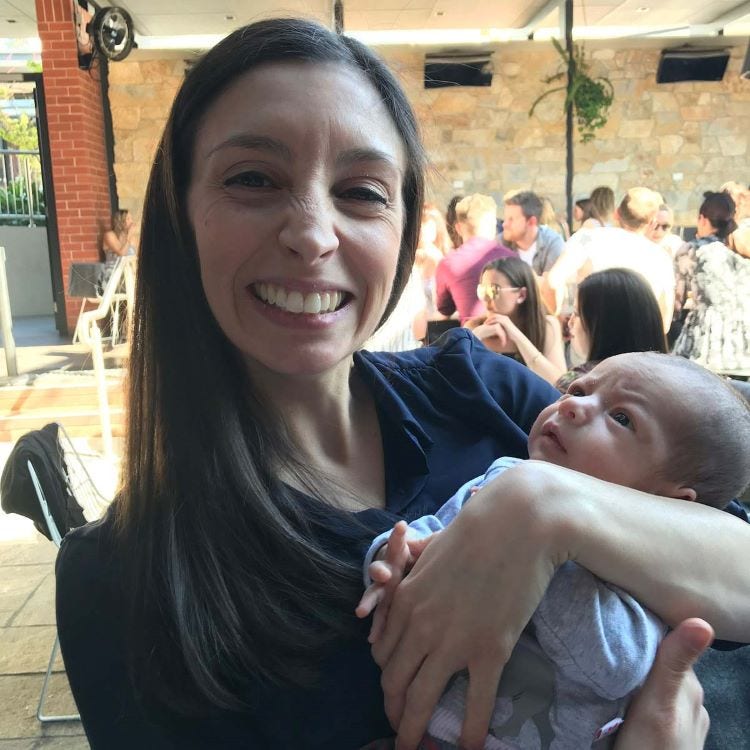
Ella is sharing her journey to parenthood to raise money for pregnancy and fertility research. Picture: Supplied
Even after an embryo is selected for transfer, IVF does not guarantee a baby. In Australia and New Zealand, live birth rates per fresh embryo transfer range from 38.9% for women under 30 to just 2.4% for women aged 45 and over.
Improving IVF success rates is a core focus of cutting-edge research happening at Adelaide University’s Robinson Research Institute, which is Australia’s only medical research institute solely dedicated to healthy human reproduction and early life health.
Associate Professor Kylie Dunning leads RRI’s Reproductive Success team.
“We’re developing new non-invasive technologies that can give us much more information about the quality and developmental potential of eggs and embryos, with the aim of helping embryologists make more objective and informed decisions about which embryo to transfer,” Associate Professor Dunning said.
“We’re also investigating how common IVF procedures, including the freezing and thawing of eggs and embryos, may affect their biology, development and longer-term outcomes.
“This is important because approximately one in six people of reproductive age worldwide experience infertility in their lifetime.
“Improving IVF success rates is critical to reducing the emotional, physical and financial burden of infertility treatment and helping more people achieve their goal of building a family.”
Both Ella and Associate Professor Dunning are encouraging people to donate to RRI on Medical Research Giving Day, a national fundraiser held on Wednesday 9 September.
“If I had been born 100 years earlier, I never would have had children. Even 50 years ago, I probably would never have had children,” Ella said.
“If there was no research in this space, so many families today just wouldn’t exist.”
Associate Professor Dunning added:
“We can all play a part in helping people to grow the families they dream of, by supporting medical research into reducing the burden of infertility, miscarriage and pregnancy complications.”
To donate to Adelaide University’s Robinson Research Institute, visit this link.
To hear more of Ella’s story, please click here.