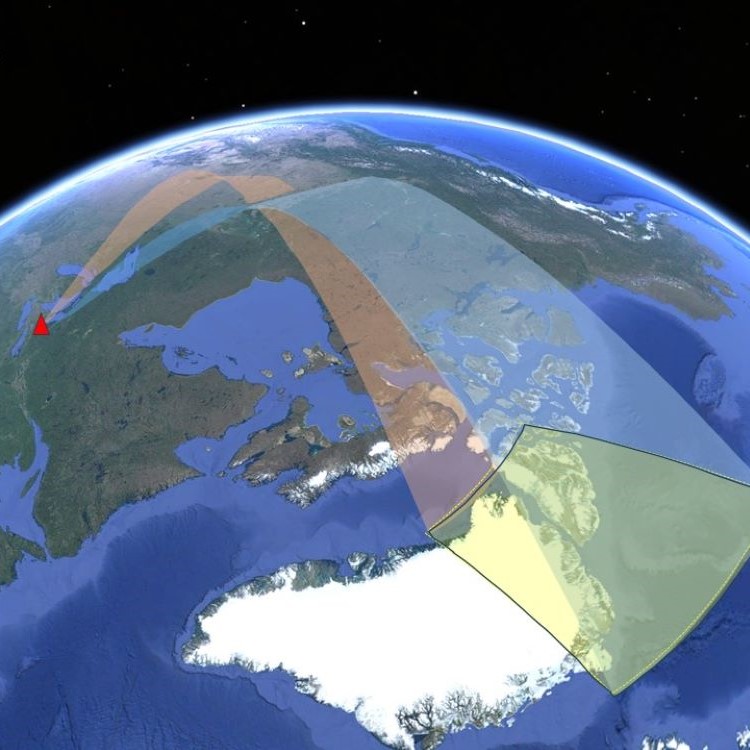
As climate change transforms the Arctic and opens new shipping routes, an internationally renowned physicist says advanced radar technology could play a key role in helping navies and governments monitor one of the world's most challenging and strategically important regions.
Adelaide University Adjunct Professor Stuart Anderson, from the School of Physics, Chemistry and Earth Sciences, has examined how high-frequency (HF) radar could support future US Navy operations in the Arctic by providing wide-area surveillance, ocean monitoring and communications support.
The Arctic is undergoing rapid change as rising temperatures reduce sea ice and increase access to waterways such as the Northern Sea Route and the Northwest Passage.
These changes are expected to drive growth in commercial shipping, resource extraction and fishing activity across the region. At the same time, strategic competition among nations is increasing, creating new security and operational challenges.
Professor Anderson recently presented a paper to the 2026 IEEE Radar Conference in Phoenix, Arizona, discussing how radar technology – already used successfully for ocean surveillance in Australia and other parts of the world – could be adapted to the Arctic’s unique environment.
According to Professor Anderson, who is also an Honorary Professor at University College London, keeping track of activities across vast and remote Arctic waters requires technologies that can monitor large areas continuously and provide timely information to decision-makers.
"Climate change is reshaping the Arctic environment and creating new opportunities as well as new risks," said Professor Anderson.
"As more vessels, infrastructure and nations become active in the region, there is a growing need for reliable systems that can help maintain awareness of what is happening across these enormous areas."
HF radar is already used in several countries for defence, maritime surveillance and ocean monitoring.
The long-range surveillance system uses high-frequency radio waves bounced off the Earth’s upper atmosphere to detect aircraft and ships far beyond direct line of sight.
Unlike many other sensing systems, HF radar can observe very large areas, operate continuously and provide information in near real time.
Professor Anderson highlights the potential for HF radar to detect and track ships, map ocean surface currents, and monitor sea conditions.
Emerging research also suggests the technology may be able to distinguish between different types of sea ice and estimate key characteristics, such as thickness and size of individual ice pieces, known as floes.
"Understanding the location, movement and nature of sea ice is critical for safe and effective operations in the Arctic," said Professor Anderson.
"HF radar has the potential to provide information that is difficult to obtain using existing systems, particularly over very large areas."
The technology could also assist communications.
Satellite coverage and environmental conditions can pose challenges, and due to the unpredictability of radio waves in the Arctic, HF radar systems may give operators a more reliable communication tool.
Professor Anderson said HF radar should not be viewed as a stand-alone solution, but as part of a broader network of sensors and monitoring technologies.
"No single technology can do everything," he said. "The greatest value comes when information from multiple systems is combined. HF radar can add unique insights that strengthen the overall picture and support better operational decisions."
Notes for editors
Professor Stuart Anderson was on the original team that designed and developed the Jindalee over-the-horizon radar (OTHR) system in 1974, enabling the Australian Defence Force to monitor air and sea movements across several million square kilometres. That same technology is now being deployed in Canada after the Australian Government signed the nation’s largest ever defence export in June 2026, in a $2.5 billion deal.