Killer Pythons, Tim Tams, Pringles and Twisties. They’re salty, sweet, crunchy, chewy – and undeniably difficult to resist. But strip these ultra-processed foods (UPFs) back to their core ingredients, and they suddenly seem a lot less appetising.
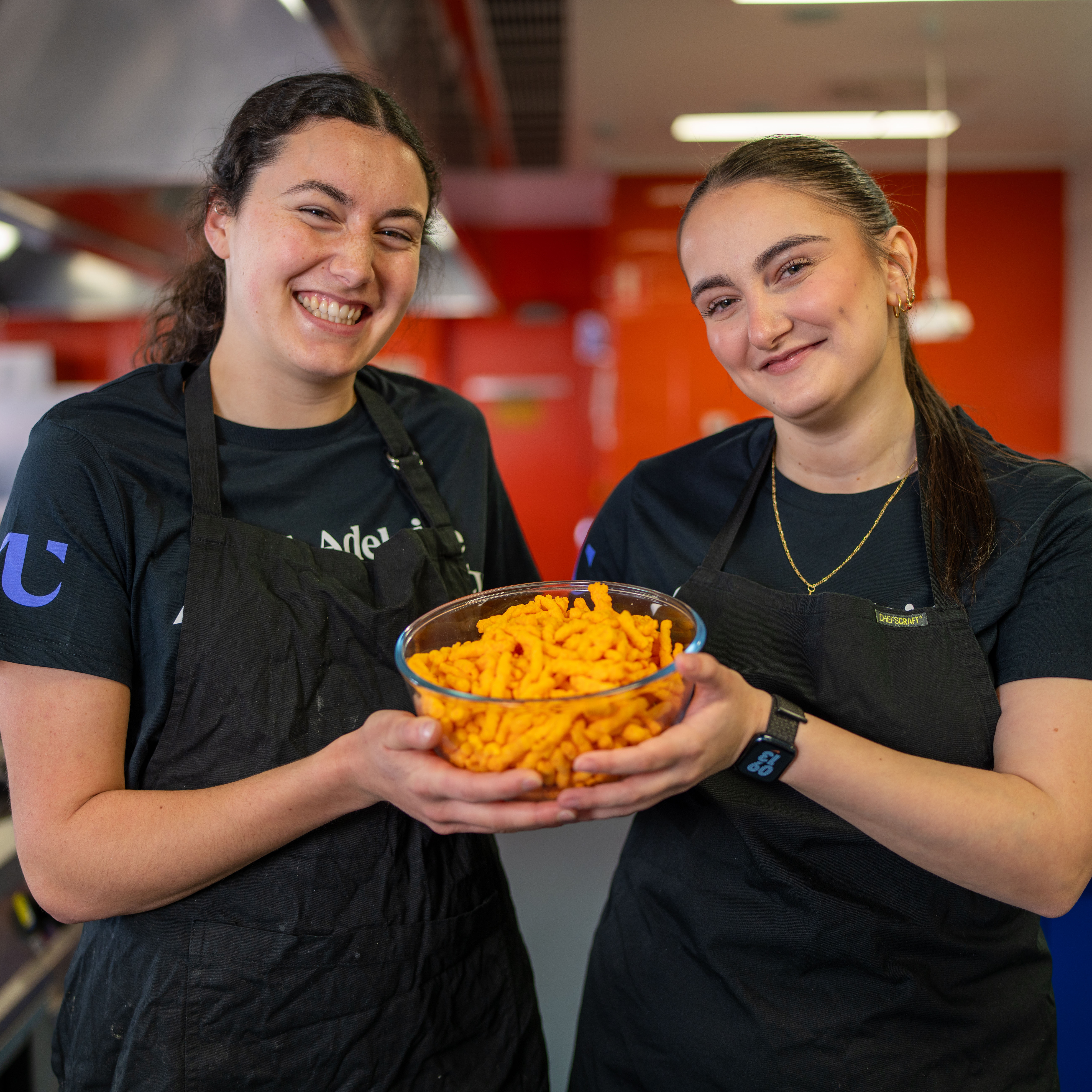
Now, Adelaide University nutrition students are getting a hands-on lesson in what really goes into ultra-processed foods by attempting to recreate an Australian snack-food classic: the Twistie.
As part of the Future Foods course, students studying Human Nutrition and Nutrition and Food Sciences are armed with supermarket ingredients and common household appliances to try to replicate the distinctive cheesy, crunchy snack.
And that’s where things get tricky. Armed with cheese, corn and rice flour, spices and a deep fryer, students quickly discover there’s a lot more to recreating a Twistie than its trademark cheesy crunch.
Dr Nina Wilson said the exercise demonstrates the differences between ultra-processed foods and everyday foods that people can make in their own kitchens.
“Twisties might look like a relatively simple snack, but trying to recreate them from everyday ingredients quickly shows students just how formulated these foods are,” Dr Wilson said.
“Ultra-processed foods typically rely on industrial ingredients, additives and specialised manufacturing processes that simply aren’t available in the average kitchen.
“That’s the lesson we want students to take away – to look beyond the finished product and understand what has gone into creating it.”
While the students manage to produce something resembling a cheese-covered snack, it’s a far cry from a Twistie. Without the high-pressure manufacturing process, precise temperatures and industrial machinery, that trademark shape, puff and crunch are almost impossible to replicate at home.
UPFs are highly formulated foods made from industrial ingredients and processes that are difficult to replicate in a home kitchen. They are very tasty and typically contain additives, while being high in energy, saturated fat, sodium or sugar and low in fibre. They include everything from soft drinks, lollies and chips to processed meats, biscuits, commercial cakes and some snack and protein bars.
In Australia, 81% of new foods released onto the market in the last decade were considered UPFs. Among products intended for children aged 5–12 years that figure rose to 93%.
The prevalence of ultra-processed foods in children’s diets is attracting increasing global attention, with the World Health Organization calling on countries to strengthen healthy eating in schools and create healthier food environments for children.
Up to half of Australians’ daily energy intake comes from UPFs, often at the expense of vegetables, fruit and whole grains. High consumption has been linked to overweight and obesity in children, and to increased risks of Type 2 diabetes, cardiovascular disease and some cancers in adults.
Associate Professor Evangeline Mantzioris said greater awareness was needed about the growing presence of UPFs in everyday diets.
“It’s unrealistic to expect people to completely eliminate ultra-processed foods from their diets, but even small swaps can make a difference,” Assoc Prof Mantzioris said.
“Snack foods are an easy place to start. Swapping out lollies, soft drinks, biscuits or packaged snack bars for fruit, nuts or homemade items can help increase the amount of whole and minimally processed foods in your diet.
“Our Twisties experiment demonstrates how ultra-processing takes ingredients away from their whole-food origins, breaks down their natural food matrix then reassembles them into a highly formulated product that looks, tastes and feels completely different.
“It’s an eye-opening experience. And once you’ve tried making a Twistie from scratch, you may never look at the packet quite the same way again.”
Notes to editors:
· National Nutrition Week runs between 12 -18 October 2026. See: National Nutrition Week 12 -18 October 2026 – Nutrition Australia
· Photos and video footage available: Twisties release | Powered by Box
………………………………………………………………………………………………………………………………………………..
Media contact:
Dr Nina Wilson School of Allied Health and Human Performance, Adelaide University.
E: nina.wilson@adelaide.edu.au
Associate Professor Evangeline Mantzioris, School of Allied Health and Human Performance, Adelaide University. E: evangeline.mantzioris@adelaide.edu.au
Annabel Mansfield, Senior Media Adviser Adelaide University. T: +61 479 182 489
E: Annabel.Mansfield@Adelaide.edu.au