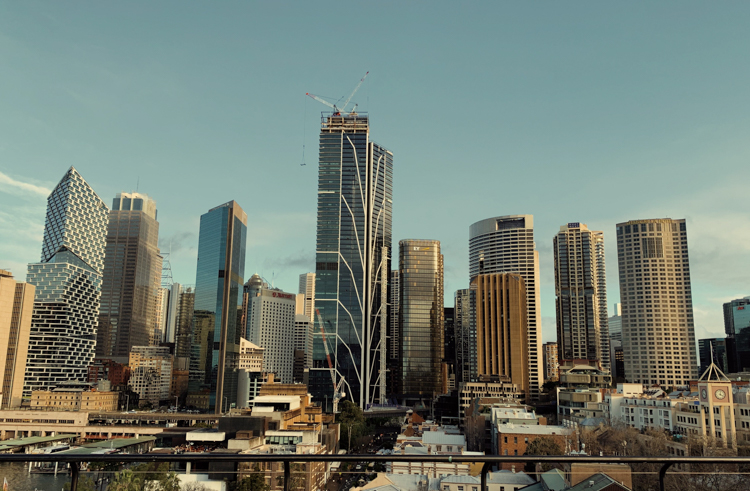
The COVID pandemic was predicted to hollow out CBDs, as businesses downsized and moved to urban locations to combat new ways of working.
But new research from Adelaide University has found the underlying demand for commercial real estate in the city centres is still strong and growing.
A team from the School of Management surveyed 789 business owners and senior managers across Australia between 2022 and 2023, collecting information on business characteristics, current location, pandemic-related operational changes, working-from-home practices, and future location preferences.
They were also presented with a series of hypothetical relocation scenarios - they could choose between moving to one of three new locations which varied on rent, floor space and proximity to CBD, or stay in their current location.
"During the peak of the pandemic, many businesses allowed employees to work from home, schools and universities partially or fully shifted to online teaching, and shopping and consumption patterns shifted rapidly to ecommerce," Dr Lynette Washington said.
"This created opportunities for people to live further from where they worked, studied or shopped and we wanted to understand if the shift in preferences to life outside of the city might extend beyond the pandemic.
"We also wanted to know which policy settings might encourage people and firms to move to regions and reduce pressure on our capitals."
The findings are published in the journal Environment and Planning A: Economy and Space.
"Firms continue to place a high premium on CBD locations, with Australian firms willing to pay around $875 per square metre per year more than current rent conditions for these locations," Professor Akshay Vij said.
"Around 34% of firms value CBD locations to the extent they'll pay $1000 per square metre per annum more for a CBD location.
"And, because the market is not in equilibrium, it is likely that some suburban firms will relocate to CBD locations in capital cities.
"The much-reported donut effect, where the centres of CBDs were predicted to hollow out due to the pandemic, has not occurred in Australia and CBDs have bounced back strongly from pandemic impacts, proving their resilience.
"These findings are supported by recent national commercial occupancy data from JLL Research which shows that demand for commercial CBD locations remains strong."
JLL Research Director Rick Warner said occupier centralisation activity has increased in almost every CBD office market during the past five years.
"While proportional centralisation to the Sydney CBD is the lowest out of Australia’s capital city CBD office markets, activity still increased from 6.2% over the five-year period from 2016-2020 to 7.4% from 2021-2025," he said.
"The largest proportional centralisation activity was recorded in Perth CBD (18.0% over the 2021-2025 period) and Adelaide CBD (16.6% over the 2021-2025 period)."
The Adelaide University research also found large cities will become "red giant cities", swallowing up the surrounding regional cities, and smaller remote places, “white dwarf cities”, will be cut off from economic development and population growth opportunities.
"This effect was already in play before the pandemic, but our findings indicate that working from home will accelerate it," Professor Vij said.
"This will be especially noticeable for regional centres that are coastal and proximate to a major centre, like the Gold Coast, Newcastle, Wollongong and Geelong.
"Eventually, there will be less distinction between these regional centres and their nearby cities as they are absorbed into the fabric of the major city."
The paper links in to previously published work by the group, analysing the impact the pandemic had on residential location preferences.
"The two research streams illustrate that firms and jobs will remain in CBDs, but workers will live further and commute longer distances, but less frequently, due to increased working from home," Dr Washington said.
"As a result, commercial CBD real estate use will intensify – firms will need less space for employees who are working remotely and thus reduce their CBD footprint, allowing more firms to move in.
"People are likely to move further away from CBDs, especially to coastal places that are near large centres.
"More people working remotely in these places will mean an increased need for services, like cafes and shops, in those suburban and regional areas."