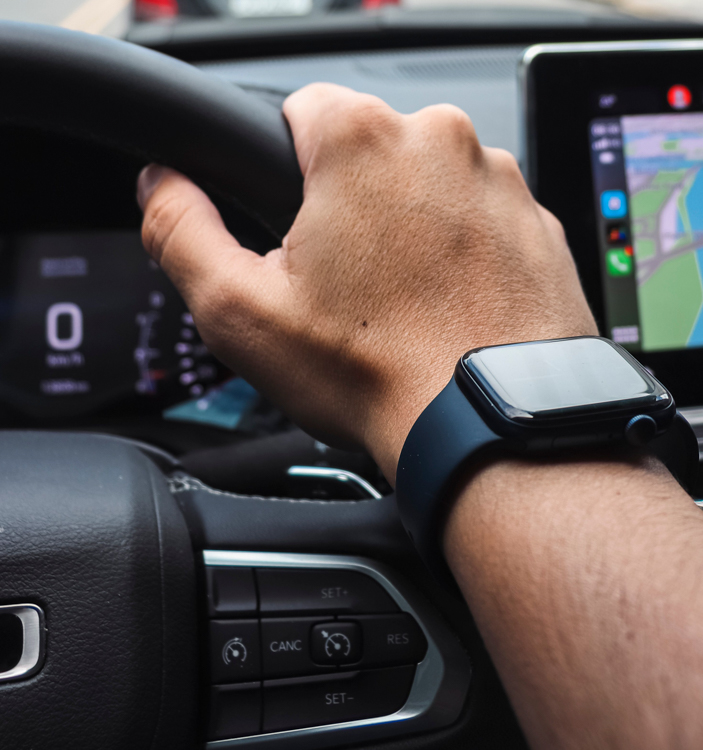
Driver distraction contributes to approximately 16 per cent of serious crashes across Australia. Now, researchers from Adelaide University’s School of Psychology are investigating whether cue utilisation helps drivers maintain performance when distracted by smartwatch notifications.
Cue utilisation refers to an individual's ability to recognise and interpret important environmental signals, enabling them to anticipate what is likely to happen next and respond appropriately, like a mental reflex.
A high level of cue utilisation means an individual has a strong ability to acquire, detect and apply relevant environmental cues — learned associations between features of a situation and what is likely to happen next — which develop implicitly through repeated exposure.
“An increased capacity of automatic processing means people with greater levels of cue utilisation are more likely to maintain performance as task demands increase compared to individuals with lower levels of cue utilisation,” said Dr Daniel Sturman from the University's School of Psychology.
“Since higher cue utilisation requires fewer working memory resources for task performance, and because distraction impacts driving by consuming limited working memory resources for driving-irrelevant tasks, we wanted to assess the relationship between cue utilisation, smartwatch distraction, cognitive load, and driving performance.”
The findings have been recently published in the journal Transportation Research Part F: Psychology and Behaviour.
“Our study featured 72 drivers who, following an assessment, were classified with either higher or lower cue utilisation,” said Dr Sturman.
“Participants then completed two simulated driving tasks around an urban 1.46 km route – once with smartwatch distractions and once without.”
The smartwatch distractions required participants to read and respond to text messages while driving. Drivers with higher cue utilisation self-reported lower cognitive load, were more likely to maintain a consistent lane position, and were less likely to suddenly swerve, compared to drivers with lower cue utilisation.
While higher cue utilisation appears to buffer some of the impact of smartwatch distraction, the researchers caution that it does not eliminate the risk. All drivers in the study reported feeling distracted by smartwatch messages, and the safest approach remains to minimise smartwatch use while driving.
“Regardless of cue utilisation level, smartwatch distraction increased drivers' cognitive load and reduced their ability to maintain a consistent driving speed,” said Dr Sturman.
“These effects were evident in both self-report measures and brain activity recordings.”
Dr Jaime Auton, also from the School of Psychology, said the findings have important implications for driver education and training.
“These findings open up exciting possibilities for driver education,” said Dr Auton.
“Cue utilisation is not simply a product of years behind the wheel. Drivers with similar levels of experience can differ substantially in this capability, suggesting it may be possible to strengthen through targeted training.
“Simulator-based training may help drivers learn to recognise and respond to key features of the driving environment more efficiently, potentially improving safety.”
Overall, the researchers believe that assessments of cue utilisation and cue-based training may provide valuable tools for improving driver safety.
“By identifying and strengthening cue utilisation, we may be able to develop more effective driver training programs that help drivers maintain performance when faced with real-world distractions,” said Dr Sturman