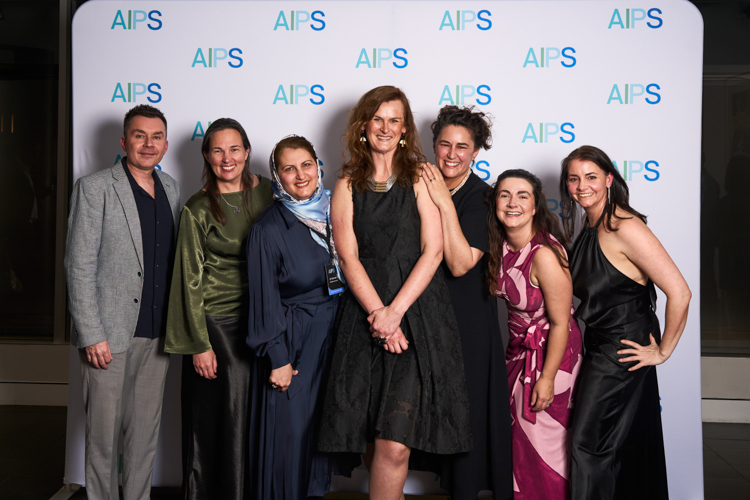
Associate Professor Ania Kotarba-Morley, a Future Making Research Fellow and an ARC DECRA Fellow from Adelaide University’s School of Humanities, and Environment Institute, was named SA Tall Poppy of the Year at a ceremony in Sydney last month.
The Young Tall Poppy Science Awards celebrate the achievements of Australia’s brightest emerging scientists and science leaders and acknowledge their contributions to research, innovation and the broader community.
Associate Professor Kotarba-Morely was recognised for her research on the impacts of climate change on cultural heritage and communities where heritage is part of the living culture, identity and connection to place and Country.
"This is particularly important for Indigenous communities, where environmental change can affect not only physical places, but the cultural knowledge, practices and relationships connected to Country," she said.
"My work addresses this gap by looking at culture and heritage as an important part of climate risk, adaptation and resilience."
Associate Professor Kotarba-Morely was one of six Adelaide University academics to be recognised by the Australian Institute of Policy & Science for their excellence in science and communication and was the overall winner.
“It is wonderful to see such a strong group of field-leading academics recognised with Young Tall Poppy Science Awards," Professor Anton Middelberg, Deputy Vice Chancellor Research & Innovation at Adelaide University, said.
Other Adelaide University researchers honoured in the South Australian 2026 Young Tall Poppy Science Awards include:
Dr Shervin Kabiri, who is an ARC Grant-Funded Senior Research Fellow from the School of Agriculture, Food and Wine. Through her research, Dr Kabiri aims to develop practical and scalable approaches to remove, destroy or immobilise PFAS (or forever chemicals), particularly from contaminated soils, water and biosolids.
Dr Luke Isbel, an Externally-Funded Senior Research Fellow, set up his own lab at the South Australian immunoGENomics Cancer Institute, in 2023. Dr Isbel works to discover new ways to manipulate the proteins that control genome regulation and have traditionally been difficult to target using conventional therapies, which is hoped to create new opportunities for treatments.
Dr Brianna Le Busque, Program Director Environmental Sciences, School of Physics, Chemistry and Earth Sciences wants to make Australia a more ocean literate society. Dr Le Busque brings a psychological lens to marine sciences, and often explores peoples' relationships with the ocean and marine species - even exploring eco-anxiety caused by the Harmful Algal Bloom event.
Associate Professor Phillipa McCormack is an ARC Externally-Funded Research Fellow from the School of Law. Her research focuses on translating biodiversity science into ambitious legal reform to help protect nature. In collaboration with government, scientists and the community, Associate Professor McCormack examines how cutting-edge conservation research can inform new ways of writing, and putting into practice, future-focused nature laws.
Associate Professor Melanie Baak, from the School of Education, is a member of the Centre in Research for Educational and Social Inclusion. Working directly with young people, educators, schools and policymakers to create more inclusive and equitable education systems, Associate Professor Baak's work has contributed to professional learning opportunities, anti-racism initiatives and policies across the state.