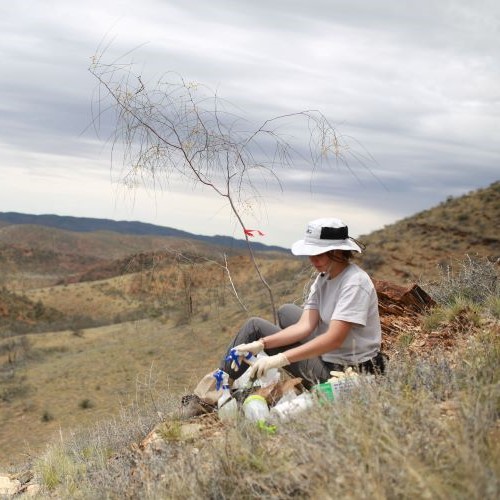
A threatened South Australian plant has been slowly declining for more than 3000 years, with new genetic research revealing it is now on the brink of extinction and should be recognised as Critically Endangered.
Researchers from Adelaide University and the University of Wollongong have used DNA from living plants to reconstruct the long-term history of the rare Spidery Wattle (Acacia araneosa), uncovering evidence that its population has collapsed by more than 99.9% over the past 3200 years, long before European settlement.
The study, published in Ecology and Evolution, shows the shrub's effective population size has fallen from around 49,000 to just over 50 over the past three millennia, with climate drying, prolonged drought, and grazing by introduced animals all contributing to its decline.
Lead author Brittany Hogben, a PhD researcher from the School of Biological Sciences at Adelaide University, said the findings provide a rare glimpse into Australia's ecological past while offering a powerful new tool for protecting threatened species.
"We analysed DNA from living plants and used statistical techniques to reconstruct the species' history," Hogben said.
"By looking at patterns in the genetic data, we can work backwards to understand how populations have changed over thousands of years and identify the pressures that have driven those changes."
The Spidery Wattle is found only in a small area around Arkaroola in South Australia's Flinders Ranges.
Researchers found its decline began during a period of increasing aridity around 3000 years ago and accelerated during more recent droughts, including the Millennium Drought. Historical grazing by sheep, goats and rabbits has also limited the plant's ability to recover by preventing young seedlings from surviving.
"It's not one single factor that's pushed this species towards extinction," Hogben said.
"It's the combination of a drying climate, recurring droughts, habitat fragmentation and grazing pressure that has slowly eroded the population over thousands of years."
The study also revealed that what was once thought to be a single population is actually two genetically distinct populations with very little exchange between them.
"This separation reduces genetic diversity and makes the species less resilient to future environmental change," Hogben said.
Although the Spidery Wattle survives only in a small pocket of Arkaroola today, active conservation efforts are already underway. Grazing exclusion fences protect remaining plants, restoration plantings have begun, and approximately 2000 seeds have been preserved by the Botanical Gardens of South Australia and the Millennium Seed Bank at Kew Gardens in the UK to support future recovery efforts.
Co- lead author Dr James Dorey from the University of Wollongong says upgrading the species to Critically Endangered status would help attract funding and international recognition for the conservation work still needed.
"Threatened species listings are one of the main ways conservation funding is allocated," Dr Dorey said.
"Getting the listing right means we have a much better chance of securing the resources needed to protect this species before it's too late.”
Beyond the fate of a single wattle species, the researchers say their approach demonstrates how modern genetics can reveal hidden chapters of Australia's environmental history and help identify species most at risk in a rapidly changing climate.
The research also confirmed that the Spidery Wattle remains a distinct species despite occasionally hybridising with the more common Silver Wattle, strengthening the case for its continued conservation.
‘Population collapse of the Spidery Wattle (Acacia araneosa) during Late Holocene aridification: genomic evidence for Critically Endangered status’ is published in Ecology and Evolution.
DOI: 10.1002/ece3.73959