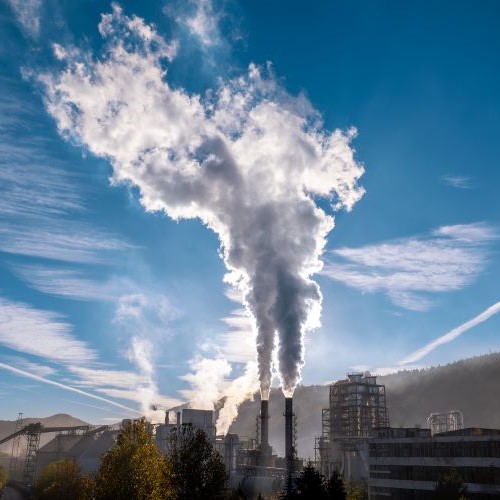
A team of international researchers has found a way to turn carbon dioxide from dirty factory emissions directly into fuel without first cleaning or purifying the gas.
The breakthrough, published in Nature Communications, overcomes one of the biggest challenges facing carbon capture technologies: the complex mix of gases found in industrial flue, a major source of global CO₂ emissions.
A scientific team led by the Université de Montpellier and Adelaide University has developed a system that uses a special organic liquid to efficiently convert CO₂ from industrial emissions into carbon monoxide (CO), a key building block used to manufacture fuels and chemicals.
Industrial flue gases typically contain only small amounts of CO₂ alongside large quantities of nitrogen and oxygen. These impurities have long hindered efforts to convert captured carbon into useful products because they trigger competing chemical reactions that reduce efficiency.
Most existing carbon capture technologies require CO₂ to be separated and purified before it can be converted into useful products, making the process both costly and energy intensive.
Adelaide University Chemical Engineering Dean, Professor Yan Jiao, said the team has developed an organic solvent mixture that weakens hydrogen bonding, suppressing unwanted side reactions, while favouring CO₂ conversion.
“Our work shows it is possible to use CO₂ directly from industrial exhaust streams without extensive purification, making carbon utilisation much more practical and potentially more economical,” Prof Jiao said.
“This could help heavy industries such as steel, alumina refining, cement, chemicals, and energy production move toward cleaner and more circular production.”
Using a simulated industrial flue gas containing 15% CO₂ and 8% oxygen, the researchers achieved almost 100% conversion selectivity to carbon monoxide. The process consumed 30.7 gigajoules of energy per tonne of CO produced, placing it among the most competitive direct carbon capture and conversion approaches reported to date.
The technology also demonstrated strong durability, operating continuously for more than 100 hours while maintaining high performance.
To explore its renewable energy potential, the team coupled the system with a high-efficiency solar cell. The integrated setup achieved a solar-to-fuel efficiency of approximately 5.5%, comparable to many systems that rely on purified CO₂ feedstocks.
Dr Damien Voiry from the Université de Montpellier said the findings highlight a promising pathway for transforming industrial emissions into valuable products while reducing the need for energy-intensive carbon capture infrastructure.
“We found that controlling hydrogen-bond interactions is the key to suppressing unwanted reactions and enabling highly selective carbon dioxide conversion,” Dr Voiry said.
“This opens a new direction for carbon utilisation technologies and could help accelerate the transition towards sustainable fuel and chemical production powered by renewable energy.”
‘Hydrogen Bond Network Disruption Enables Efficient Direct Reactive Capture of CO₂ from Flue Gas’ is published in Nature Communications. The paper is authored by researchers from the Université de Montpellier, Adelaide University, Shaanxi University of Science & Technology, and Southwest Jiaotong University. DOI: 10.1038/s41467-026-74647-z