It's just a matter of time before people return to the lunar surface, and this time to stay there. This will require a lot of infrastructure on the Moon.
But before anything can be built on the Moon, lunar construction practices will need to be refined on Earth, in simulated lunar environments.
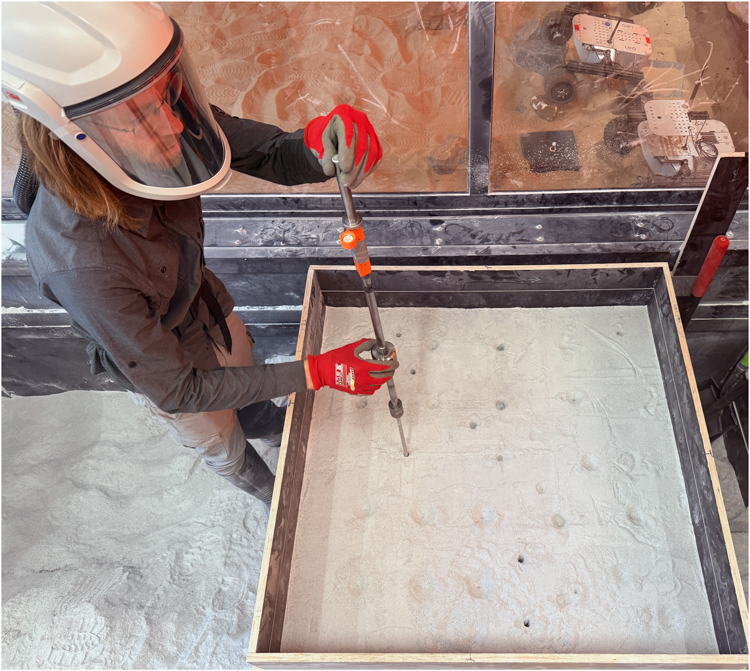
Researchers from Adelaide University’s Andy Thomas Centre for Space Resources have been playing their part by investigating the effectiveness of cone penetrometers in the lunar surface.
Cone penetrometers have been routinely used to measure in-situ soil strength in civil engineering and mining industries for a long time. They have been taken to the Moon, including later Apollo missions, but difficulty with penetrating the lunar surface was experienced or the tools couldn’t go deep enough.
“If we are building infrastructure, like buildings, roads, or landing pads, on the surface of the Moon, we need to get as much information as we can like penetration resistance, density and layering,” said PhD candidate Kārlis Šļumba.
“We developed and tested a bespoke dynamic cone penetrometer with variable cone size and hammering energies.”
The results have been published in the journal Acta Astronautica.
“We tested both a dynamic cone penetrometer and a static cone penetrometer – the main difference between the two is how the cone is hammered into the ground,” said Šļumba.
“While a static cone penetrometer might be more precise on Earth, the key advantage of a dynamic cone penetrometer is that it can penetrate harder layers by increasing the number of hammer strikes.”
The team created a compaction chamber inside the regolith pit at the Adelaide University’s Extraterrestrial Environmental Simulation (Exterres) laboratory, and tested different cones and hammering energies at varying densities of simulated lunar regolith (lunar soil).
“The findings can be used directly for lunar payload development and the interpretation of results, that will help with the construction of the future lunar base,” said Šļumba.