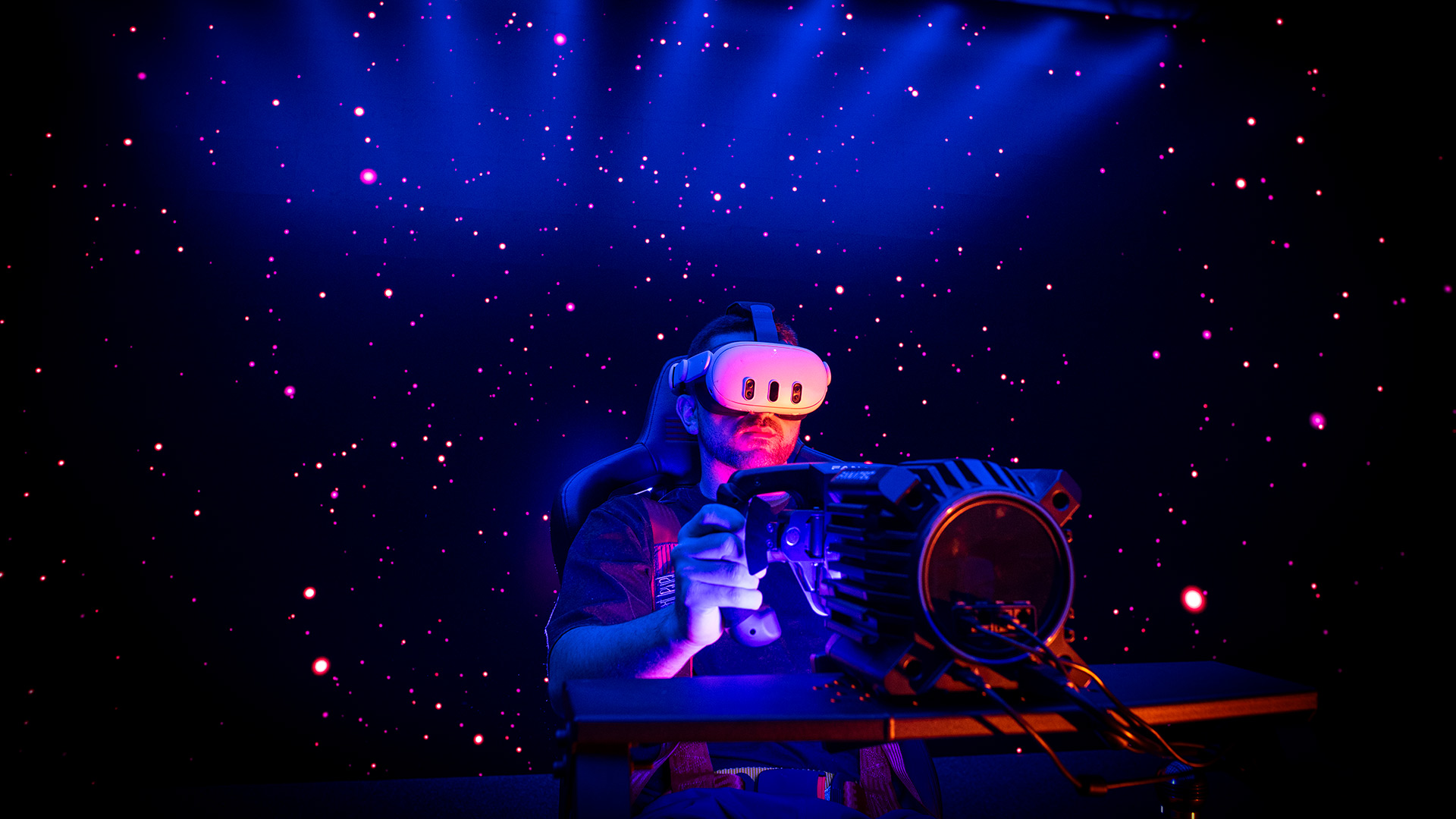
Innovation through immersive media technologies, computer science, visual arts, and engineering
The Adelaide Lab for Immersive Technologies (ALIT) is a research lab based in the Australian Research Centre for Interactive and Virtual Environments at Adelaide University.
ALIT blends expertise across immersive technology, computer science, visual arts, and engineering to produce technological innovation. Our lead researchers Senior Lecturer Steven Cook and Professor Edward Palmer bring together in-house, cutting-edge tools for simulation, interactive display, motion tracking, and digital performance to support academic research, industry collaboration, performance, and teaching.
Our mission is to advance the boundaries of knowledge and build capability to enable industrial transformation through high quality research.
We offer
- Research-based consultancy and training for immersive technology adoption and capacity building
- Large scale infrastructure design and builds for immersive technology
- 3D printing and rapid prototyping
Since its establishment in 2019, ALIT has driven innovation in immersive media research to deliver impact across industry sectors.
Examples include:
- Space: VR lunar rover simulation, featuring a drivable electric rover with Hexapod motion integration and real moon terrain data.
- Medicine: VR surgery simulation and interactive, multi-user training in immersive environments.
- Creative Industries: 3D scanning/printing, graphics and sound creation for immersive installations, live performances, gaming and heritage visualisation projects.
Our facilities include:
- 7.8-metre high-resolution LED wall with full interactivity
- Motion capture systems for analytics and human factors-based research
- Electro-muscle stimulation suits
- Powered truss for project-specific control, projection mapping, and multi-source comms
- Four suspension harness points to simulate weightlessness for immersive scenario testing
- Land and aerial vehicle simulation systems
- Separate control room with programming access for performance and isolated control, with lighting control systems.