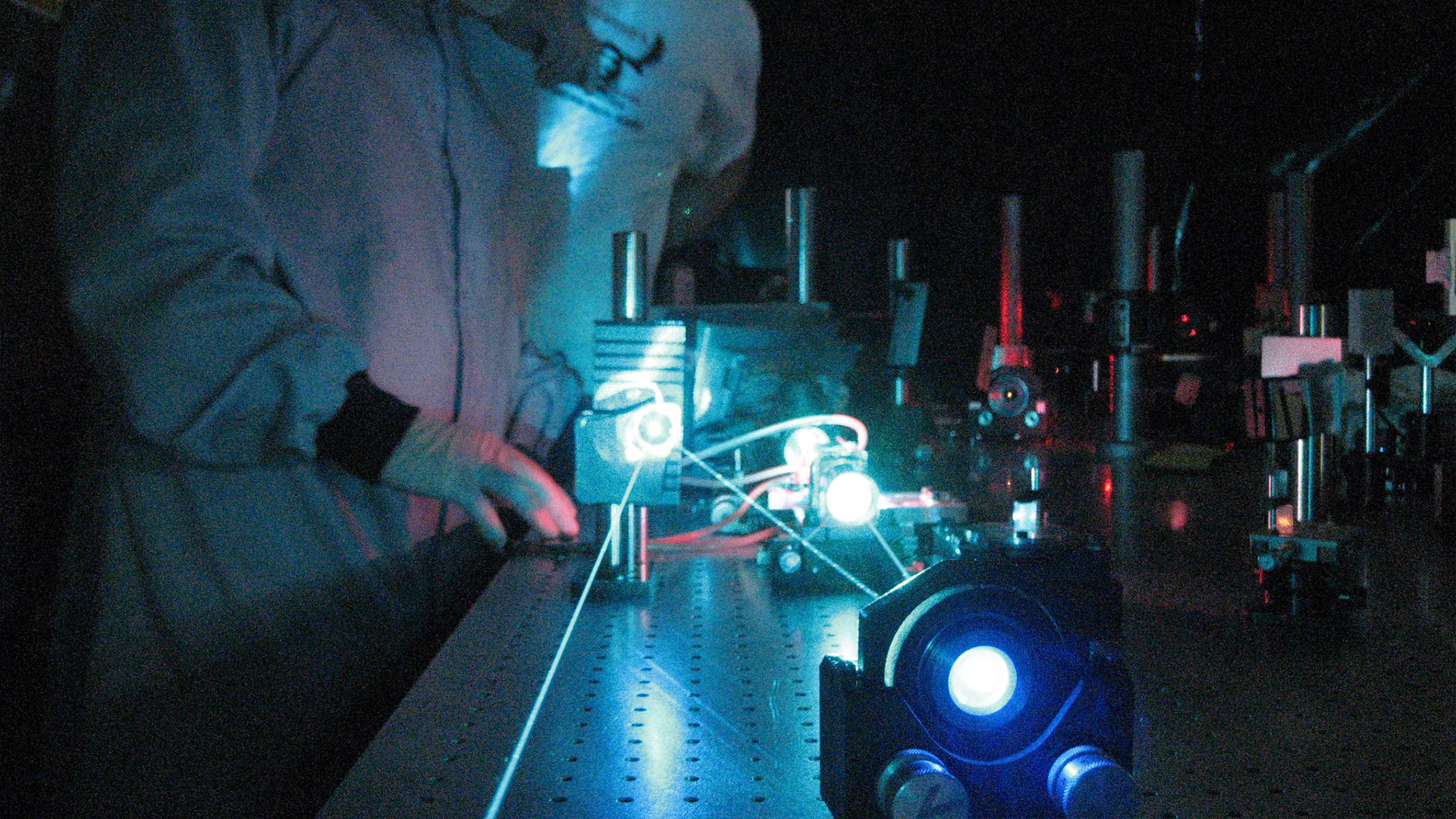
Our research spans a broad range of academic, defence, scientific and commercial applications.
Defence
Our research in ultrashort-pulse and nanosecond-pulse, high-repetition-rate laser technologies supports the development of next-generation defence capabilities. These advanced laser systems enable directed-energy applications, precision target detection and tracking, long-range sensing, and advanced countermeasures. By combining high precision, scalability, and reliability, our research contributes to Australia's sovereign defence capability and future security technologies.
Ultrafast Chemistry
The interaction of ultrashort, high-energy laser pulses with matter enables the investigation of ultrafast physical and chemical processes. Mid-infrared wavelengths are particularly important because many organic molecules exhibit strong vibrational absorption bands within this spectral region.
Advanced Materials Processing and Manufacturing
The extremely high peak power of ultrashort pulses enables nonlinear absorption and plasma formation in a wide variety of materials. As a result, USPLs have become an enabling technology for advanced manufacturing.
Laser processing of polymers, glass and ceramics produces exceptionally clean cuts, minimal heat-affected zones and contamination-free surfaces, offering significant quality and cost advantages over conventional manufacturing methods.
High-Harmonic Generation and Soft X-rays
High-energy ultrashort mid-infrared pulses enable the generation of attosecond extreme-ultraviolet (XUV) and soft X-ray radiation through high-harmonic generation (HHG).
DualTech-USPL's 2 μm laser technology occupies the "Goldilocks" wavelength region—long enough to efficiently extend harmonic generation towards shorter wavelengths while maintaining high conversion efficiency. These systems have the potential to produce compact "table-top" X-ray, proton and electron sources for medical, industrial and scientific applications.
Remote Sensing
Many atmospheric gases exhibit strong absorption features within the mid-infrared spectral region, creating unique molecular fingerprints that enable highly sensitive detection.
USPL systems therefore offer powerful tools for environmental monitoring, trace-gas sensing and defence surveillance. In biomedical applications, ultrashort pulses enable precise tissue removal while minimising thermal damage and reducing inflammatory responses.
Biomedical Applications
Medical laser technology continues to expand rapidly, particularly within ophthalmology.
Ultrashort-pulse laser systems offer improved precision, reduced collateral tissue damage and faster recovery times across a broad range of procedures, including refractive surgery, cataract treatment, glaucoma management, retinal surgery and oculoplastic procedures.
These applications require high-energy broadband or tunable narrowband mid-infrared laser sources capable of delivering exceptional beam quality and pulse control.
Quantum Technologies and Space
Ultrashort-pulse laser systems provide precise control of wavelength, linewidth, power, polarisation, spatial mode and temporal pulse characteristics, making them valuable tools for emerging quantum technologies.
In space applications, advanced laser systems can generate radiation environments that simulate space conditions, enabling the testing of materials and electronic systems prior to launch. These capabilities complement South Australia's growing investment in the space sector.
Clean Fusion Energy
Ultrashort-pulse lasers have become central to inertial fusion energy research. In December 2022, laser-driven fusion experiments at Lawrence Livermore National Laboratory achieved net energy gain, marking a historic milestone towards practical fusion power.
This breakthrough has accelerated international efforts to develop the world's first commercial fusion power plants and positions high-power laser technology at the forefront of future clean-energy research.
Hydrogen Production
Fusion energy has the potential to become an efficient source of hydrogen production by supplying both electricity and high-grade heat. Combining thermal energy with electrolysis could significantly improve hydrogen production efficiency.
Nuclear Waste Transmutation
High-power ultrashort-pulse lasers are also being investigated as a potential method for transmuting long-lived radioactive isotopes into shorter-lived products, reducing long-term storage requirements for nuclear waste.
Collaboration
Collaboration underpins every aspect of the DualTech-USPL research program.
We work closely with defence organisations, universities, research institutes, industry partners and government agencies to accelerate innovation and translate research into practical capability for Australia.
The DualTech-USPL Research Group maintains close collaboration with the ultrashort-pulse laser discipline within the Defence Science and Technology Group (DSTG) and leads research activities in hypersonics and countermeasures through Defence Trailblazer.
The Defence Trailblazer for Concept to Sovereign Capability is a $250 million initiative led by the University of Adelaide and the University of New South Wales, supported by the Australian Government to accelerate Australia's sovereign defence capability.