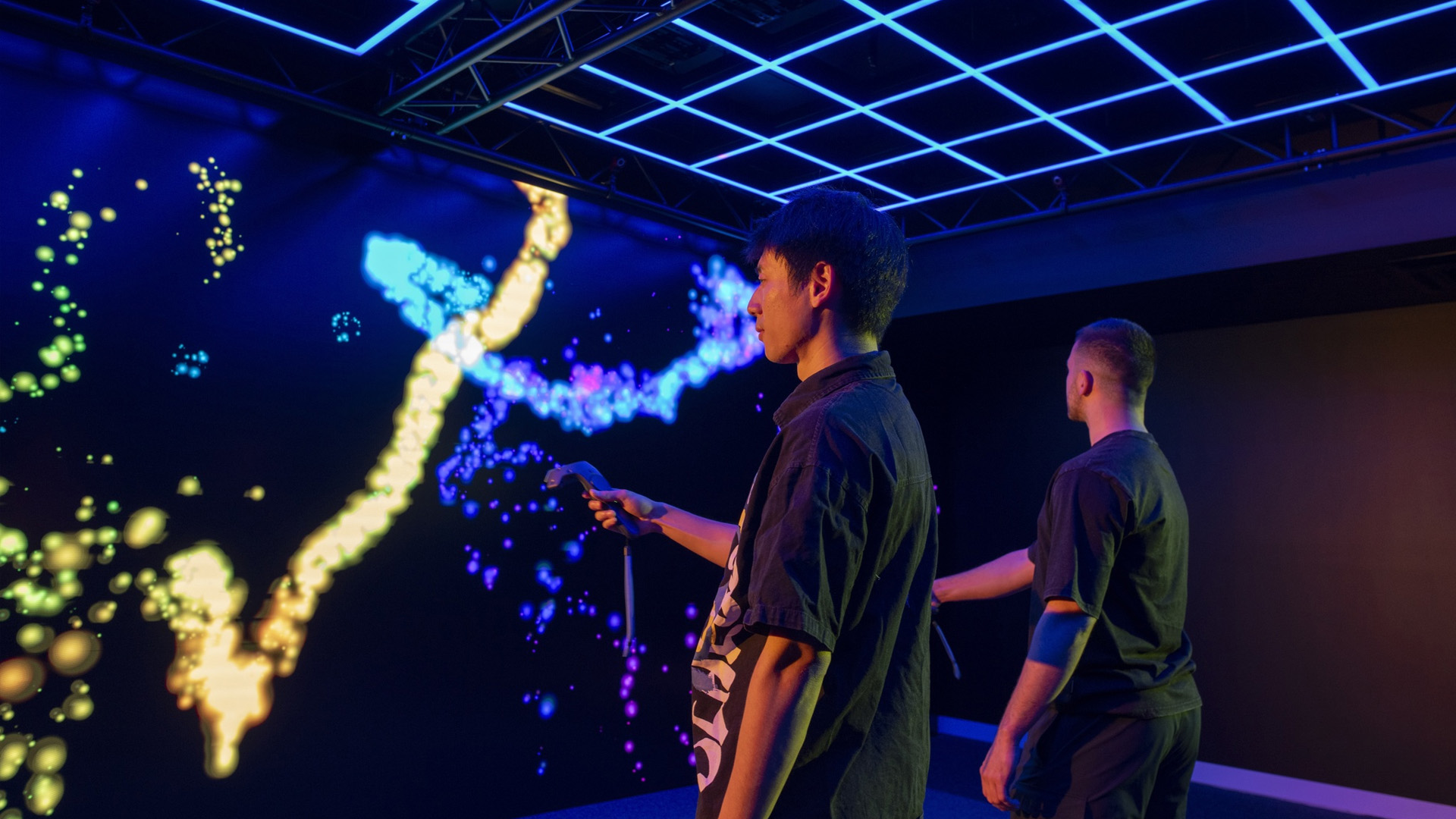
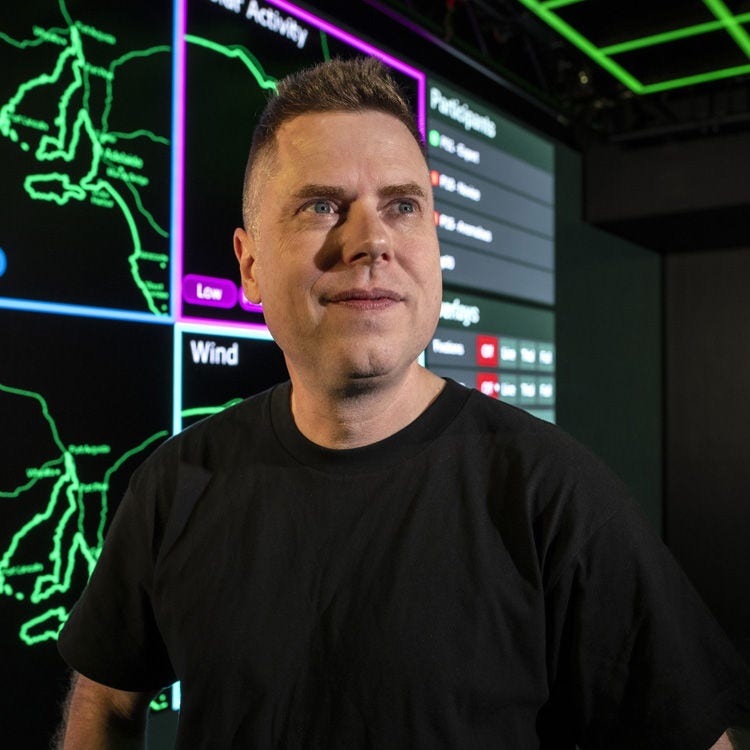
“ALIT treats immersive technology research as a creative instrument, not just as a display,” Cook says. “Partnerships with ILA and MOD. enabled users to explore our technologies for artistic output, and do so through embodied interaction.”
These artworks require custom-made virtual production tools that track physical camera position to render content in real-time. To better this tech, Cook continues to study how humans move, perceive and respond in digital environments at the University’s world-leading Australian Research Centre for Interactive and Virtual Environments (IVE). He says accurate measurements of human movement are crucial across areas like healthcare, rehabilitation and ergonomics – but often tricky to capture in clinical or real-world settings. Cook is working to address this challenge by applying this research with complex immersive activities at the ALIT lab. These closely mirror real-world scenarios, encouraging natural movements for convenient observation.
“This is invaluable movement data,” Cook says. “It has traditionally relied on specialised motion-capture laboratories equipped with multiple cameras, body-mounted markers, and carefully controlled testing environments. But now, researchers can gather this data at Adelaide University in a much easier and more affordable way.”
Beyond the arts, ALIT researchers work on a range of projects to solve industry needs. Lunar rover simulations allow participants to practise driving on the moon. Professor Anna Ma-Wyatt’s human-autonomy teaming research is improving the working relationship between people, AI and space technologies. Medical simulators help medical and defence personnel practise emergency surgery in realistic scenarios and educate health students on how to correctly operate and remove equipment.
In another ALIT project, researchers are using VR to support patients with chronic pain. Chronic pain affects more than 3.5 million Australians, many of whom experience delayed diagnosis, financial distress, and workforce drop out as a result, according to Chronic Pain Australia’s 2025 White Paper. The report finds more than 70% of those affected experience mental health impacts, and 65% leave the workforce prematurely. Chronic pain is projected to cost Australia’s economy a projected $215.6 billion by 2050. Professor Paul Rolan is leading Sound Escape, a project in collaboration with the Northern Pain Rehabilitation Clinic that aims to support recovery by creating an illusion of pain-free movement, helping patients break the fear-avoidance cycle.
“There is a desperate clinical need for better therapies for chronic pain,” says Rolan, who is a professor of Clinical Pharmacology at the University. “Drug treatments are often disappointing, and other physical therapies have limited impact.”
For many patients, pain creates a fear of movement, which can reinforce and worsen the problem. VR helps break this cycle by changing how movement is perceived. The technology allows patients to “see” themselves moving more freely, helping recondition the brain to expect movement without pain. They can also virtually build their own musical compositions, visually removing them from their clinical setting. This further shifts attention away from the pain.
“It would be difficult to achieve this without a VR approach,” says Professor Rolan. “Excitingly, our systems may lead to new therapeutic outcomes for patients with chronic pain.”
On the horizon
As the field of VR continues to grow, Adelaide University’s infrastructure and expertise will become increasingly valuable for industry and research. The global VR market is projected to reach more than US$488 billion ($700 billion) within the next decade, according to a Roots Analysis market forecast – and the University will be well positioned to strengthen Australia’s sovereign capability in this space. With real-time immersive systems, teams will be able to prototype products, environments and experiences at full scale. They can see if complex ideas work and how people respond to them – before anything is built in the real world. From arts and engineering to medicine and space exploration, VR will continue to change industries, adding huge value to users and the economy.
Advanced tracking and full-body data capture, like the research work at ALIT and IVE, will support more precise, scalable studies of human behaviour. Future applications may be capable of automatically identifying movement issues, predicting injury or fall risk, tailored rehabilitation programs, and more accurate real-time feedback. Rather than occasional clinical measurements, immersive media technologies will contribute to ongoing data-driven processes that support health and performance over time.
As these technologies mature, they will be able to replace specialised lab setups – expanding who can use them, and accelerating the translation of research into real-world applications.