

Why Bachelor of Laboratory Medicine (Honours)?
Make the diagnosis that could save lives as an accredited medical laboratory scientist.
Medical laboratory scientists play a significant role in Australia’s health system. Working in diagnostic pathology laboratories across Australia, they support clinicians by diagnosing, managing and treating diseases through testing patient samples, conducting research into the causes and cures of disease, and developing improved methods for disease detection. The skilled professionals who analyse, interpret and report on this data are crucial in helping clinicians and their patients make informed, timely and life-saving treatment decisions. They also play a critical role in shaping public health initiatives, including disease prevention efforts and developing new diagnostic tests.
Apply your inquisitive and analytical mind in a career where you can make a real and lasting impact.
Overview
Gain the skills and knowledge needed to work as a medical laboratory scientist in diagnostic pathology or research.
Develop core knowledge of the natural and biomedical sciences, and their application in diagnostic pathology. Learn how to perform diagnostic tests, including cross-matching for blood transfusions, identifying infection-causing organisms, screening for cancer cells and detecting genes responsible for disease conditions. Undertake training in all areas of pathology, including biochemistry, microbiology, immunology, molecular pathology, haematology and histopathology.
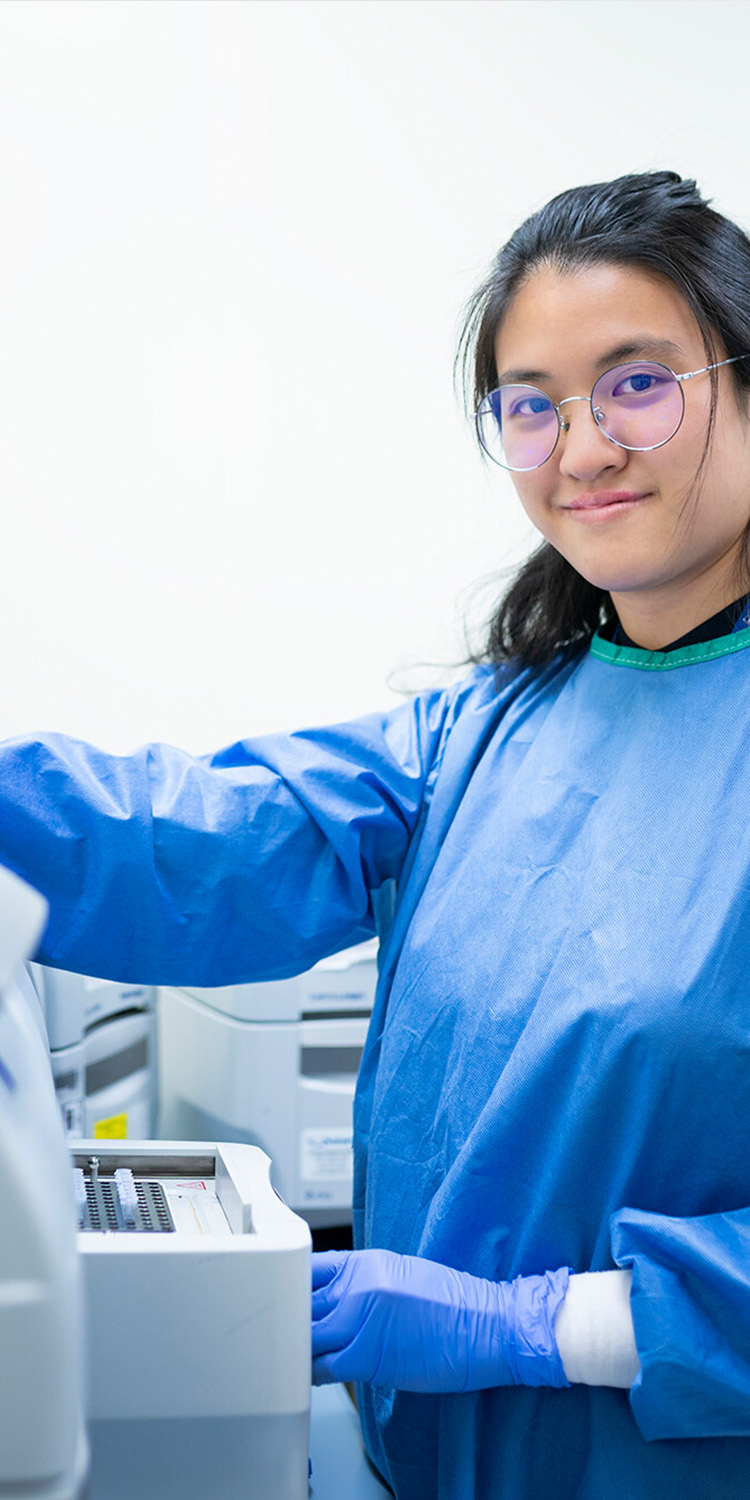
Put your learning into practice in a variety of private, public, community and allied health settings with up to 26 weeks of clinical placements. Get hands on in our purpose-built histopathology and haematology laboratories, where you’ll use industry-standard technology to perform, analyse and interpret test results. Gain advanced research skills and contribute new knowledge to the field through a major honours research project.
Through a comprehensive blend of theory, practical experiences and clinical placements you’ll develop the skills to expertly diagnose disease. You’ll graduate with the knowledge, skills and experience to thrive in your medical laboratory career – in whatever setting you choose.
Key features
 Learn how to diagnose, monitor and research human disease.
 - Gain the skills and knowledge needed to work as a medical laboratory scientist in diagnostic pathology or research.
- Complete a major research project or clinical practice placement in an area of interest.
- Hone your technical skills in our purpose-built histopathology and haematology laboratories.
- Undertake 26 weeks of clinical laboratory placements within a range of private and public laboratories.
- Get experience in all areas of pathology including biochemistry, microbiology, immunology, molecular pathology, haematology and histopathology.
What you'll learn
Taught over four years, our Bachelor of Laboratory Medicine (Honours) provides you with a solid foundation in the theoretical and practical aspects of pathology, with training in biochemistry, microbiology, immunology, molecular pathology, haematology and histopathology.
In first year, you’ll be introduced to core biomedical sciences topics in chemistry, anatomy, mathematics and quantitative health research methods. Second year will expand your knowledge of pathological processes, with courses in areas such as:
- Biochemistry
- Haematology
- Genetics
- Histology
- Immunology
- Microbiology
- Pathophysiology.
During your third and fourth years, you’ll strengthen your knowledge and skills further through clinical courses and professional placements. Under the supervision of professionally accredited and experienced medical laboratory scientists, you’ll gain valuable experience working in real diagnostic laboratories across a wide range of public and private medical laboratories.
You’ll learn in dedicated facilities, including our purpose-built histopathology and haematology laboratories. Here, you’ll learn how to conduct diagnostic testing using industry-standard technologies and processes.
In your final year, you can choose to undertake Advanced Clinical Practice for 13 weeks or Experimental Research Practice for 13 weeks. In both options, you’ll work as part of a team in a diagnostic or research setting, learning how to manage specimens, perform tests and operate equipment.
You’ll graduate with the qualifications necessary to register and practice as a medical laboratory scientist in Australia.

Degree Structure: Bachelor of Laboratory Medicine (Honours)
Program code: HLABM
Complete 192 units comprising:
- 144 units for all Core courses, and
- 48 units for Work integrated learning
Study plan
A study plan sets out the courses you will need to complete and the recommended timing for each one. This will help to guide your enrolment in each study period, alongside any additional information provided below. If you have received a personalised plan or alternative advice from your Program Director, please refer to that guidance in the first instance, or seek help from your Program Director or Student Assist if you are unsure.
Enrolment information
Find details about the rules and notes that apply to your program, along with other essential information required for successful enrolment. Supplementary supporting resources may also be provided where applicable.
Courses
Listed here are all the courses that contribute to your program, including elective options that can be chosen. These courses come together to form your study plan. Courses fall into different categories, each of which have specific unit values that need to be met under the program rules.
What courses you'll study
Complete 192 units comprising:
- 144 units for all Core courses, and
- 48 units for Work integrated learning
Complete 144 units for ALL of the following:
| Course name | Course code | Units | |
|---|---|---|---|

|
Course name
Human Physiology 100
|
Course code
BIOL1018
|
Units
6
|
|
|
Course name
Human Physiology 101
|
Course code
BIOL1019
|
Units
6
|
|
|
Course name
Biochemistry
|
Course code
BIOL2027
|
Units
6
|
|
|
Course name
Genetics
|
Course code
BIOL2030
|
Units
6
|
|
|
Course name
Histology
|
Course code
BIOL2033
|
Units
6
|
|
|
Course name
Immunology
|
Course code
BIOL2034
|
Units
6
|
|
|
Course name
Chemical and Molecular Pathology
|
Course code
BIOL3023
|
Units
6
|
|
|
Course name
Genomics and Bioinformatics
|
Course code
BIOL3029
|
Units
6
|
|
|
Course name
Microbiology
|
Course code
BIOL3044
|
Units
6
|
|
|
Course name
Chemistry 100
|
Course code
CHEM1005
|
Units
6
|
|
|
Course name
Chemistry 101
|
Course code
CHEM1006
|
Units
6
|
|
|
Course name
Mathematics for Laboratory Sciences
|
Course code
MATH1024
|
Units
6
|
|
|
Course name
Professional Issues in Laboratory Medicine
|
Course code
MDST1002
|
Units
6
|
|
|
Course name
Pathophysiology
|
Course code
MDST2009
|
Units
6
|
|
|
Course name
Essential Haematology
|
Course code
MDST2010
|
Units
6
|
|
|
Course name
Histotechnology
|
Course code
MDST3004
|
Units
6
|
|
|
Course name
Infectious Diseases
|
Course code
MDST3005
|
Units
6
|
|
|
Course name
Transfusion and Haemostasis
|
Course code
MDST3008
|
Units
6
|
|
|
Course name
Clinical Biochemistry
|
Course code
MDST4000
|
Units
6
|
|
|
Course name
Advanced Haematology
|
Course code
MDST4001
|
Units
6
|
|
|
Course name
Histopathology and Cytopathology
|
Course code
MDST4002
|
Units
6
|
|
|
Course name
Specialised Microbiology
|
Course code
MDST4003
|
Units
6
|
|
|
Course name
Data Skills for Scientists
|
Course code
STAT1000
|
Units
6
|
|
|
Course name
Health, Society and Systems
|
Course code
PUBH1002
|
Units
6
|
Notes
1. Students may only enrol in the following Semester 2 courses if they have previously completed (and attempted all assessment components) in the corresponding Semester 1 course(s), viz: CHEM1006 - Chemistry 101, BIOL1019 Human Physiology 101, BIOL2034 - Immunology, BIOL2030 - Genetics, MDST2009 - Pathophysiology, and MDST2010 - Essential Haematology.
Work Integrated Learning description
WIL courses give you real‑world experience as part of your degree.
Complete 48 units comprising:
- 24 units for all Work integrated learning courses, and
- Either:
- 24 units for all Work integrated learning - advanced clinical practice, or
- 24 units for all Work integrated learning - experimental research practice
| Course name | Course code | Units | |
|---|---|---|---|
|
|
Course name
Clinical Practice A
|
Course code
MDST3006
|
Units
12
|
|
|
Course name
Clinical Practice B
|
Course code
MDST3007
|
Units
12
|
| Course name | Course code | Units | |
|---|---|---|---|
|
|
Course name
Advanced Clinical Practice A
|
Course code
MDST4004
|
Units
12
|
|
|
Course name
Advanced Clinical Practice B
|
Course code
MDST4005
|
Units
12
|
| Course name | Course code | Units | |
|---|---|---|---|
|
|
Course name
Experimental Research Practice A
|
Course code
MDST4006
|
Units
12
|
|
|
Course name
Experimental Research Practice B
|
Course code
MDST4007
|
Units
12
|
Notes
-
Work integrated learning courses - 1. Students are required to undertake MDST3006 - Clinical Practice A, MDST3007 - Clinical Practice B, MDST4004 - Advanced Clinical Practice A, and MDST4005 - Advanced Clinical Practice B in an approved pathology laboratory. Students may be required to undertake Clinical Practice in a regional laboratory. Placement outside South Australia may be allowed.
3. Students who are employed in an appropriate laboratory setting may be granted full credit for these courses.
4. Students granted full credit in MDST3006 Clinical Practice A, MDST3007 Clinical Practice B, MDST4002 Advanced Practice A and MDST4003 Advanced Practice B, and who successfully complete courses in Study Period 2, third year are permitted to enrol in the corresponding fourth year, Semester 2 courses (i.e. they are exempt from the requirements to complete all third year Semester 1 courses before enrolling in any fourth year Semester 2 courses).

Career outcomes
As a medical laboratory scientist, you'll support clinicians in the diagnosis, management and treatment of disease. You may recommend treatments, monitor dosage and effects, and track the progress of patients. Medical laboratory scientists also play a pivotal role in making new medical discoveries, developing improved tests for disease detection and shaping public health initiatives.
You might be based in hospital, conducting diagnostic tests on blood and bodily fluids to monitor how patients are responding to treatment. Perhaps you’ll be employed by a pharmaceutical company, helping develop and prepare new types of medicines for clinical trials.
Medical laboratory scientists are employed in a wide range of areas, including:
- Clinical biochemistry
- Cytology
- Diagnostic pathology
- Forensic science
- Government policy
- Haematology
- Histopathology
- Immunology
- Medical microbiology
- Product manufacturing
- Public health and health management
- Research
- Transfusion science
- Veterinary medicine
- Virology.
Industry trends
The healthcare and social assistance sector is the single largest employing industry in Australia. However, more than four out of five health professional occupations had a workforce shortage in 2023 (AIHW, 2023). As projected demand for healthcare services increases, so too will the need for professionals with the expertise to undertake, analyse and interpret the sheer volume of diagnostic testing that comes along with it. This suggests that the job outlook for medical laboratory scientists is highly favourable.
Additional trends driving up demand for medical laboratory scientists are Australia’s ageing population and the increase of people living with chronic health conditions. By 2066, older Australians will make up over 20% of the total population (AIHW, 2024). As we age, our reliance on healthcare services grows, along with our risk of chronic conditions that affect major body systems.
Accreditation
This program is accredited by the Australian Institute of Medical and Clinical Scientists (AIMS) . Graduates are eligible for membership with the AIMS as well as the Australasian Association of Clinical Biochemists (AACB) & the Australian Society for Microbiology (ASM).
Ready to apply?


Your study experience and support
Adelaide University sets you up for success in your studies – and your social life. You’ll have access to work placement and internship opportunities, overseas study tours and exchanges, networking events with guest speakers and more. Our campuses are equipped with purpose-built facilities including lecture theatres, libraries, workshops, laboratories, and spaces that simulate real work environments. These are all supported by the latest technologies and a 24/7 online learning platform with personalised study information and resources.
You’ll have everything you need to live well and thrive during your studies, with health services on campus, gymnasiums, technology zones and modern student lounges. Get involved in campus sport or join our student clubs that will connect you to your passions – and the people who share them.
Adelaide also has a variety of accommodation options to suit your individual requirements and budget, with options ranging from dedicated student accommodation to private rentals. One of the world’s most liveable cities, Adelaide has lots of leafy parks, gardens and social hubs – and some of the highest living standards globally. No matter where you are in Adelaide, you’re only a short distance from beaches, vineyards, museums, art galleries, restaurants, bars and parklands. Visit the accommodation web page to find out more.
Student services
We’re here to support you on your student journey. Adelaide University offers a range of support services and facilities, including:
- Career advice and mentoring services
- Personal counselling
- LGBTQIA+ support
- Academic support
- Fees and finance help
- Security services
- Accommodation services
- Common rooms
- Prayer rooms.
You’ll also have unlimited access to our dedicated student support hub. Visit in-person or online, or contact our friendly team by phone. We can assist you with anything study-related including enrolment, identification cards, timetables, fees and more.

Your program team

Your campus
You'll be studying at one of our renowned campuses, accessing cutting-edge facilities and contemporary study spaces.
Study hours
Your courses will require a combination of different learning formats, including lectures, tutorials, workshops, seminars and practicals. Aside from your classes, you’ll also need to allocate additional time for independent study. This may include assignments, readings, projects and contributing to online discussion forums. As a rough guide, full-time studies may require 12-26 hours of class time and 14-18 hours of independent study per week.
Assessment
During your studies at Adelaide University, you’ll complete a mixture of practical, professional and research-based learning. Your assessment types will vary depending on the degree you’re studying, but may include:
- Case studies
- Essays and assignments
- Examinations
- Group projects
- Internships and placements
- Practicals
- Presentations
- Reports and project documentations
- Research projects
- Workplace and classroom contributions.