

Why Master of Science?
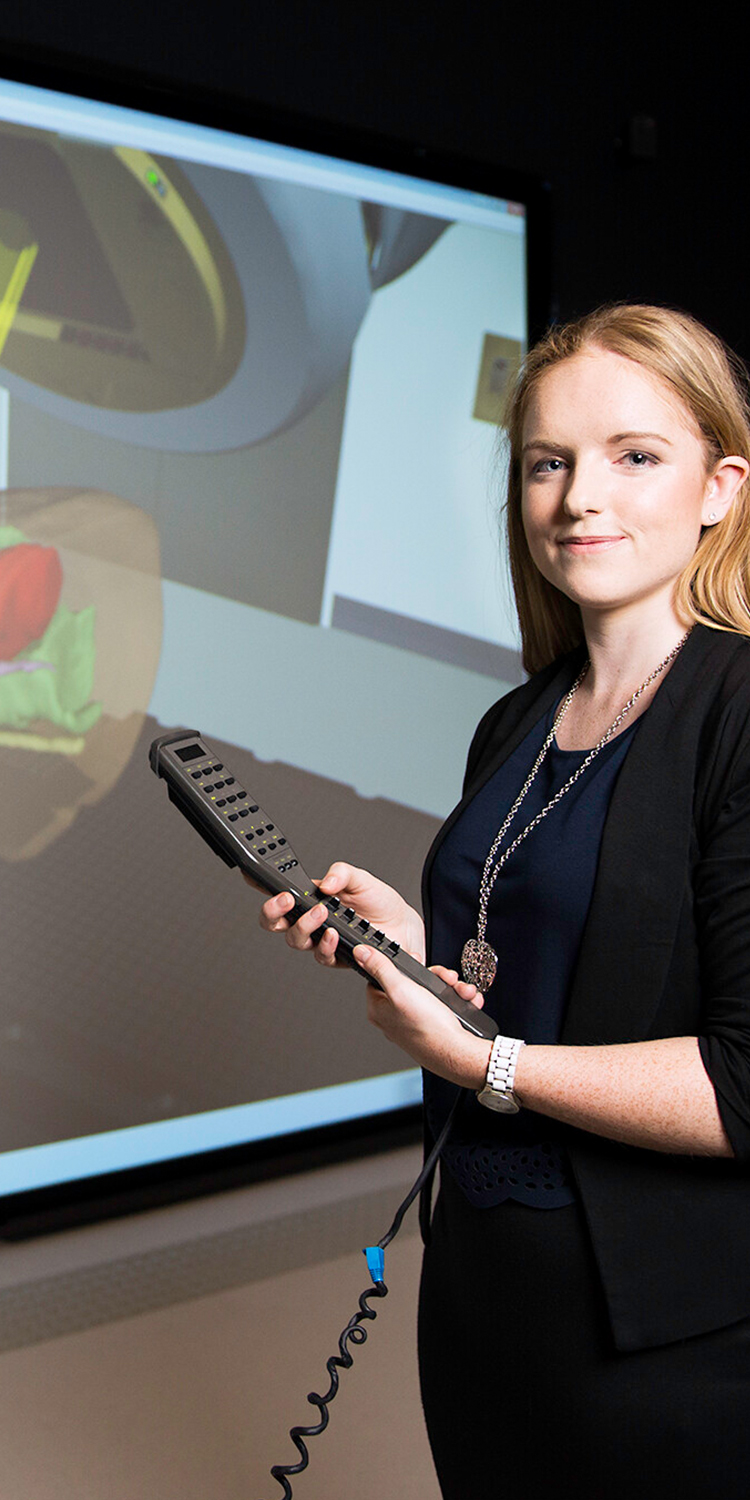
The fight against cancer now has a powerful new weapon: proton therapy. Unlike traditional radiation therapy, proton therapy uses positively charged particles to target tumours with incredible precision. This advanced treatment offers significant benefits – minimising damage to healthy tissue, reducing side effects and enabling treatment in sensitive areas like the brain. It also offers new hope to children and adolescents battling cancer.
Our Master of Science specialising in Medical Radiation Physics will prepare you for a rewarding career in a growing sector. Discover how to produce high quality images while minimising patient risk. Learn from highly accomplished academics and medical physicists. Apply your knowledge of physics to the development and use of medical radiation treatments, devices and technologies. Bridge the gap between science and medicine and revolutionise effective treatments in modern healthcare.
Overview
The Master of Science specialising in Medical Radiation Physics will advance your knowledge in the medical application of physics principles. Focus on the use of radiation for diagnosing and treating diseases. Through theoretical application, you’ll learn how to minimise patient risk and optimise radiation dose delivery.
Build a deeper understanding of the anatomy and physiology of organs, crucial to understanding the effects of treatment. Embark on a scientific research project, deep diving into a specialised clinical area of interest under the guidance of academics in the field. Our degree also provides a strong foundation of knowledge and skills necessary for undertaking additional study and clinical training in this area.
You’ll graduate ready to begin the journey of improving and developing cancer diagnoses and treatments. Enhance patient outcomes and take part in the growing and cutting-edge global proton therapy market.
Key features
 Develop high level problem-solving and communication skills.
- Master theoretical and practical aspects of mathematics and physics.
- Learn from highly accomplished and internationally experienced medical physicists.
- Collect, analyse, evaluate and synthesise data relating to physics and medical physics.
- Study specific theory in radiation therapy and build your knowledge in common treatment sites.
- Build your skills in research methodology to undertake a research project in second year.
What you'll learn
This degree focuses on the application of physics principles and techniques to deliver effective and safe radiation treatments. Study theoretical and applied radiation physics and the use of astrophysics in medicine. Develop an understanding in the main methods of medical imaging, including X-ray, nuclear medicine and ultrasound. Solve problems in physics using computational methods to overcome challenges.
In your second year, you’ll build skills in experimental physics, including atomic and nuclear physics. Apply data analysis and modelling to experimental designs to discover useful information, draw conclusions, and support decision-making. Further your studies in radiation therapy and learn specific theory in common treatment sites and their applications in real-world scenarios.
Build your knowledge and skills by completing a scientific research project in your final year. Collaborate with industry professionals and academics to develop and present a report in an area of interest. Gain experience in research methodology and enhance your skills for future professional endeavours.
Throughout your studies, you’ll learn core skills in science research communication and data management. Grasp the ethical considerations in science including the use of artificial intelligence.
This degree offers flexible hybrid delivery, which includes a mix of on-campus and online study. Apply theoretical concepts and conduct experiments in practical classroom settings and collaborate with your peers in online learning environments.
Specialisations
The Master of Science is also available with specialisations in the following:

Degree Structure: Master of Science specialising in Medical Radiation Physics
Program code: MASCI
Complete 96 units comprising:
- 78 to 96 units for one Major from Specialisations, and
- 0 to 18 units for Electives
Study plan
A study plan sets out the courses you will need to complete and the recommended timing for each one. This will help to guide your enrolment in each study period, alongside any additional information provided below. If you have received a personalised plan or alternative advice from your Program Director, please refer to that guidance in the first instance, or seek help from your Program Director or Student Assist if you are unsure.
Enrolment information
Find details about the rules and notes that apply to your program, along with other essential information required for successful enrolment. Supplementary supporting resources may also be provided where applicable.
Courses
Listed here are all the courses that contribute to your program, including elective options that can be chosen. These courses come together to form your study plan. Courses fall into different categories, each of which have specific unit values that need to be met under the program rules.
What courses you'll study
Complete 96 units comprising:
- 78 to 96 units for one Major from Specialisations, and
- 0 to 18 units for Electives
Complete exactly 66 units from the following:
| Course name | Course code | Units | |
|---|---|---|---|

|
Course name
Nuclear and Radiation Physics 3
|
Course code
PHYSX302
|
Units
6
|
|
|
Course name
Human Biology for Medical Physics
|
Course code
BIOL5019
|
Units
6
|
|
|
Course name
Physics of Medical Imaging
|
Course code
PHYS5003
|
Units
6
|
|
|
Course name
Radiation Therapy Studies 1
|
Course code
RADI2002
|
Units
6
|
|
|
Course name
Radiation Therapy Studies 2
|
Course code
RADI3008
|
Units
6
|
|
|
Course name
Radiation Biology, Protection and Epidemiology
|
Course code
RADI5000
|
Units
6
|
|
|
Course name
Radiotherapy Physics
|
Course code
RADI5001
|
Units
6
|
|
|
Course name
Computational Physics
|
Course code
PHYSX300
|
Units
6
|
|
|
Course name
Experimental Physics
|
Course code
PHYSX301
|
Units
6
|
|
|
Course name
Data Analysis and Modelling
|
Course code
INFO6010
|
Units
6
|
|
|
Course name
Research Theory and Practice in Science
|
Course code
BIOL6800
|
Units
6
|
Work Integrated Learning description
WIL courses give you real‑world experience as part of your degree.
Complete 18 units comprising:
- 18 units from Work integrated learning
Work Integrated Learning description
WIL courses give you real‑world experience as part of your degree.
| Course name | Course code | Units | |
|---|---|---|---|
|
|
Course name
Medical Radiation Physics Research Project A
|
Course code
BIOL6900
|
Units
6
|
|
|
Course name
Medical Radiation Physics Research Project B
|
Course code
BIOL6901
|
Units
12
|
Electives description
A flexible course choice within your degree.
Complete 0 to 18 units comprising:
- 0 to 18 units from University-wide electives
A full list of university-wide elective options can be accessed below.
University-wide elective optionsElectives description
A flexible course choice within your degree.
Complete 6 units comprising:
- 6 units from Closed electives
| Course name | Course code | Units | |
|---|---|---|---|
|
|
Course name
Radiation Safety in the Workplace
|
Course code
EART5010
|
Units
6
|
|
|
Course name
Advanced Differential Equations
|
Course code
MATHX300
|
Units
6
|
|
|
Course name
Optics and Photonics 3
|
Course code
PHYS3004
|
Units
6
|
|
|
Course name
Statistical Methodology
|
Course code
STATX302
|
Units
6
|

Career outcomes
Play a key role in modern healthcare, encompassing both diagnostic imaging and therapeutic procedures. The field of medical radiation physics offers diverse career paths, each contributing significantly to healthcare through the safe and effective use of radiation.
You might work in a cutting-edge proton therapy clinic, planning and optimising radiation treatments for cancer patients. You could design radiation treatment plans in collaboration with radiation oncologists and ensure accuracy of dose delivery through testing and verification. Maybe you’ll be a research scientist, conducting and overseeing clinical trials to test new treatments.
Graduates can pursue roles as a:
- Medical physicist (with further study)
- Medical researcher
- Physicist.
Industry trends
With the opening of the Australian Bragg Centre for Proton Therapy and Research – the first proton therapy centre in the Southern Hemisphere – South Australia is poised to become a world leader in this area.
Increased investment, advanced technologies and a growing global market means proton therapy is set to become a multi-billion dollar industry by 2032 (Precedence Research, 2023). Specialists in this field are in short supply but high demand globally, providing excellent career prospects for Adelaide University graduates.
Accreditation
This program is accredited by the Australasian College of Physical Scientists & Engineers in Medicine. Graduates are eligible for membership of the ACPSEM.
Ready to apply?


Your study experience and support
Adelaide University sets you up for success in your studies – and your social life. You’ll have access to work placement and internship opportunities, overseas study tours and exchanges, networking events with guest speakers and more. Our campuses are equipped with purpose-built facilities including lecture theatres, libraries, workshops, laboratories, and spaces that simulate real work environments. These are all supported by the latest technologies and a 24/7 online learning platform with personalised study information and resources.
You’ll have everything you need to live well and thrive during your studies, with health services on campus, gymnasiums, technology zones and modern student lounges. Get involved in campus sport or join our student clubs that will connect you to your passions – and the people who share them.
Adelaide also has a variety of accommodation options to suit your individual requirements and budget, with options ranging from dedicated student accommodation to private rentals. One of the world’s most liveable cities, Adelaide has lots of leafy parks, gardens and social hubs – and some of the highest living standards globally. No matter where you are in Adelaide, you’re only a short distance from beaches, vineyards, museums, art galleries, restaurants, bars and parklands. Visit the accommodation web page to find out more.
Student services
We’re here to support you on your student journey. Adelaide University offers a range of support services and facilities, including:
- Career advice and mentoring services
- Personal counselling
- LGBTQIA+ support
- Academic support
- Fees and finance help
- Security services
- Accommodation services
- Common rooms
- Prayer rooms.
You’ll also have unlimited access to our dedicated student support hub. Visit in-person or online, or contact our friendly team by phone. We can assist you with anything study-related including enrolment, identification cards, timetables, fees and more.

Your program team
Dr Tyron Turnbull
Program Director
College of Science
School of Physics, Chemistry and Earth Sciences

Your campus
You'll be studying at one of our renowned campuses, accessing cutting-edge facilities and contemporary study spaces.
Study hours
Your courses will require a combination of different learning formats, including lectures, tutorials, workshops, seminars and practicals. Aside from your classes, you’ll also need to allocate additional time for independent study. This may include assignments, readings, projects and contributing to online discussion forums. As a rough guide, full-time studies may require 12-26 hours of class time and 14-18 hours of independent study per week.
Assessment
During your studies at Adelaide University, you’ll complete a mixture of practical, professional and research-based learning. Your assessment types will vary depending on the degree you’re studying, but may include:
- Case studies
- Essays and assignments
- Examinations
- Group projects
- Internships and placements
- Practicals
- Presentations
- Reports and project documentations
- Research projects
- Workplace and classroom contributions.