Our exams

Our exams

Conducting AMEB exams across our wide range of syllabuses.

As AMEB is also licensed to deliver Rockschool and Stageschool exams in Australia, we offer contemporary music and performing arts qualifications alongside AMEB’s traditional offerings. Whether candidates are just beginning, building skills, or pursuing advanced study, our syllabuses and exams provide clear pathways and outcomes that support individual learners, teachers, studios and schools.

Many practical exams from Grade 5 are approved by the SACE Board as Community Learning and can be counted towards the SACE at Stages 1 and 2.

AMEB’s practical music syllabuses and exams cover orchestral instruments, classical guitar, piano, voice, teaching, ensemble and more, ranging from beginner/preliminary standard to AMEB’s prestigious Associate and Licentiate Diplomas.


  • Keyboard: P-Plate Piano, Piano (inc. Collaborative option), Piano for Leisure, Organ
  • Strings: Violin, Viola, Cello, Double Bass, Classical Guitar, Harp
  • Woodwind: Bassoon, Clarinet, Flute (inc. Piccolo option), Recorder, Oboe, Saxophone, Saxophone for Leisure
  • Orchestral Brass: Horn, Trumpet, Trombone, Bass Trombone, Tuba, Euphonium
  • Band: Concert Band and Brass Band - Bb, Eb and C instruments
  • Voice: Singing, Singing for Leisure and Musical Theatre
  • Percussion
  • Ensemble performance: Strings, Woodwind, Brass, Percussion or other mixed ensembles
  • Music Teaching

LEVELS 1 and 2 (Preliminary to Certificate of Performance)
Grading CodeGrading NameDescriptor 
A+High DistinctionIn addition to satisfying the requirements for an A grading, the candidate demonstrates outstanding achievement in meeting the syllabus objectives, including stylistic and interpretive confidence and technical fluency.
HonoursThe candidate demonstrates an overall excellent level of achievement in meeting the syllabus objectives, including convincing attention to style, interpretation, and technique.
B+High Credit The candidate satisfies the requirements for a B grading at a higher standard.
BCreditThe candidate demonstrates an overall creditable level of achievement in meeting the syllabus objectives. Some unevenness of achievement in meeting the syllabus objectives or between different Sections of the examination may be apparent. 
C+Satisfactory with MeritThe candidate satisfies the requirements for a C grading at a higher standard.
SatisfactoryThe candidate demonstrates an overall adequate level of achievement in meeting the syllabus objectives. Unevenness of achievement in meeting the syllabus objectives or between different Sections of the examination may be apparent.
DNot Satisfactory The candidate demonstrates an overall inadequate level of achievement in meeting the syllabus objectives. Considerable unevenness of achievement in meeting the syllabus objectives or between different Sections of the examination may be apparent.
LEVEL 3 – DIPLOMAS
Associate Diploma (AMusA); Licentiate Diploma (LMusA)  
GradingAwardDescriptor
DistinctionAward with DistinctionThe candidate has fulfilled the criteria for a pass award and in addition demonstrated performance flair, consistent technical and musical command, and penetrating stylistic insight.
Pass AwardThe candidate has fulfilled the syllabus objectives to a level that meets the technical and musical demands of the repertoire and produced a satisfying musical performance overall.
No AwardNo Award The candidate has not demonstrated an overall adequate level of musicianship, technique, and style, resulting in a performance that has not fulfilled the requirements for the award.

P Plate Piano (Piano only)

Books 1, 2 and 3 (performance-only, non-graded)

AMEB practical music

Level 1: Preliminary to Grade 4

Level 2: Grade 5 to Grade 8/Certificate of Performance

Level 3: Associate Diploma (AMusA) and Licentiate Diploma (LMusA)


With the exception of For Leisure syllabuses, practical Grades 6 to Diploma qualifications include a music theory co‑requisite requirement.

The ‘General requirements for practical examinations’ section of any downloaded music syllabus outlines what different exam types are available and what’s included in them.

Exam typeFace-to-face examVideo exam
P Plate PianoYY
ComprehensiveYN
RepertoireY
Certificate of Performance & Diploma YN
Performance evaluations (offered for Diploma candidates).YContact the office

Comprehensive examinations in Preliminary to Grade 8 comprise three sections:

  • Section I – Technical Work
  • Section II – Studies and Pieces (sometimes referred to in a Syllabus as a Program)
  • Section III – Aural Tests, Sight-Reading and General Knowledge.

Repertoire exams comprise one section only – pieces:

  • 4 pieces (3 list and 1 own choice) for Level 1 (Preliminary to grade 4)
  • 5 pieces (3 list and 2 own choice) for Level 2 (Grades 5 – 8)

The pieces and studies (works) are taken from the Comprehensive or For Leisure syllabus Lists for that instrument and Grade, as specified in the relevant Syllabus. While technical work is still important and relevant for exam preparation, repertoire exams allow candidates to focus on their technique through repertoire and have the flexibility to choose a range of repertoire styles, including own choice works.

Piano for Leisure, Saxophone for Leisure, and Singing for Leisure exams are available in both Comprehensive and Repertoire format, noting these distinctions:

  • Candidates are given the choice between aural tests and sight-reading in the Leisure syllabuses. 
  • There is no additional requirement to pass any grade of Theory of Music, Musicianship or Music Craft.
  • There is no Certificate of Performance exam available in the For Leisure syllabuses.

P Plate Piano exams are non-graded, performance-only assessments that candidates can undertake at the completion of each of the three AMEB P Plate Piano books.

Examinations for Certificate of Performance, Associate Diploma and Licentiate Diploma comprise two sections:

  • Section I – Studies and Pieces (sometimes referred to in a Syllabus as a Program)
  • Section II – General Knowledge.

Video exams

Exams that only include a performance component can be completed via Video. These include P Plate Piano exams and all Repertoire exams. The exam is prepared and submitted via pre-recorded video, made under exam conditions according to AMEB SA & NT specifications.

Build skills in reading, writing and understanding music from beginner to specialised theory. Theory exams support practical study and can meet co‑requisites for higher level practical music qualifications.


  • Theory of Music
  • Musicianship
  • Music Craft

Music theory exams up to Grade 6 are scored as a percentage. Results are issued as:

  • High Distinction (95-100%)
  • Honours (85-94%)
  • Credit (75-84%)
  • Pass (65-74%)
  • Not Satisfactory (0-64%)

 Diploma theory exam results are issued as:

  • Award with Distinction (85-100%)
  • Award (65-84%)
  • No Award (0-64%)

Theory of Music

Grade 1 to Grade 6

Associate and Licentiate

Musicianship

Grade 1 to Grade 6 (from Grades 4 to 6, Aural is examined separately)

Associate (written and aural exams) and Licentiate (written and aural exams)

Music Craft

Preliminary to Grade 6


Successful completion of Grades 2 to 6 Theory is often a co-requisite component for formal practical (Grade 6 to Diploma) qualifications. Check the regulations published in any practical and written music syllabus to find out more.


Exam typeFace-to-face examVideo exam
PreliminaryNY
Grades 1 to 4Y (Theory of Music only)Y
Grades 5 and 6Y (Theory of Music and Music Craft only)Y (Theory of Music and Musicianship only)
DiplomaYN

AMEB’s Speech & Drama examinations include practical performance and communication exams (Speech and Performance Practical, Voice and Communication, and Drama and Communication), as well as Speech and Performance Theory online exams. The exams provide structured pathways, clear milestones and feedback to support skills development in speech, voice and dramatic art.


Speech and Performance Practical 

Develops secure vocal technique, integrated physical response, and imaginative and insightful presentation of texts. A creative syllabus that builds interpretative and performance skills across a broad spectrum of styles, genres and eras, with opportunities to combine performance skills within a single examination. 

Voice and Communication (Practical syllabus)

Develops voice and communication skills for everyday life and the professional sector, helping candidates read effectively, speak with clarity, and make presentations to a variety of audiences. 

Drama and Communication (Practical syllabus)

Focuses on performing arts through creative dynamics (an improvisational approach) and is especially designed for ensemble work (groups of 2 or more). The program emphasises listening, concentration and movement alongside the art of drama and entertainment, and works well with drama studios and classroom cohorts.

Speech and Performance Theory 

Speech and Performance Theory exams are an opportunity to show understanding of the functional framework of speech and performance. The exams are designed to have relevance for a wide range of candidates, focusing on progressive consolidation of knowledge relating to dramatic performance, oral interpretation and spoken interaction in a variety of communication situations. 

Speech and Performance Theory students learn how to master communicating the English language. Students focus on the theory and analyse the functional framework of English communication. Students explore linguistic tools, vocal modulation, the use of phonetic tools and the study of theatre and communication theory.

This syllabus supports learning undertaken in the practical Speech and Drama subjects. In higher grades, the syllabuses align as follows:

  • Grade 6 Speech and Performance, Voice and Communication, Drama and Performance all align with Grade 4 Speech and Performance Theory
  • Grade 7 Speech and Performance, Voice and Communication, Drama and Performance all align with Grade 5 Speech and Performance Theory
  • Grade 8 Speech and Performance, Voice and Communication, Drama and Performance all align with Grade 6 Speech and Performance Theory
  • CSPA, CVCA, CDPA practical certificates all align with Grade 7 Speech and Performance Theory
Practical exam grading up to Certificate

Grading codeGrading nameDescriptor
A+High DistinctionIn addition to satisfying the criteria for the award of an A grading, the candidate demonstrates outstanding achievement in all areas of performance and preparation. For Drama and Communication, where a duo or group, they demonstrate outstanding achievement in all areas of teamwork.
AHonoursThe candidate demonstrates an overall superior level of achievement in terms of reading accuracy, rhythmic sense, stylistic insight, performing presence, audience awareness, and preparation of topics. For Drama and Communication, where a duo or group, they demonstrate superior achievement in all areas of teamwork.
B+High CreditIn addition to satisfying the criteria for the award of a B grading, the candidate demonstrates meritorious achievement against most criteria. For Drama and Communication, where a duo or group, they demonstrate meritorious achievement in all areas of teamwork.
BCreditThe candidate demonstrates an overall creditable level of achievement, with appropriate development of reading accuracy, rhythmic sense, stylistic insight, performing presence, audience awareness, and preparation of topics. Some unevenness of achievement between these criteria, or different parts of the examination, may be apparent. For Drama and Communication, where a duo or group, they demonstrate creditable achievement in all areas of teamwork.
C+Satisfactory with MeritIn addition to satisfying the criteria for the award of a C grading, the candidate demonstrates more than adequate achievement against some of the criteria. For Drama and Communication, where a duo or group, they demonstrate more than adequate achievement in all areas of teamwork.
CSatisfactoryThe candidate demonstrates an overall adequate level of achievement in reading accuracy, rhythmic sense, stylistic insight, performing presence, audience awareness, and preparation of topics. Considerable unevenness in achievement between these criteria, or different parts of the examination, may be apparent. For Drama and Communication, where a duo or group, they demonstrate adequate achievement in all areas of teamwork.
DNot SatisfactoryThe candidate demonstrates an overall inadequate level of reading accuracy, rhythmic sense, stylistic insight, performing presence, audience awareness, and preparation of topics. Often this results from deficiencies in preparation or a hesitant presentation evidencing technical errors and an inappropriate sense of style. For Drama and Communication, where a duo or group, they demonstrate inadequate achievement in all areas of teamwork.

Diplomas (Associate and Licentiate)

Grading nameDescriptor
Award with DistinctionAwarded to a candidate whose work is of an exceptional standard.
AwardAwarded to a candidate who has met the requirements of the examination.
No AwardThe candidate has not met the requirements of the examination.

Speech and Performance Theory grading

Theory results are assigned a percentage score. Results are issued as:

  • High Distinction (95-100%)
  • Honours (85-94%)
  • Credit (75-84%)
  • Pass (65-74%)
  • Not achieved (0-64%) 

Drama and Communication

Introductory, then Grades 1 to 6

Voice and Communication

Preliminary, then Grades 1 to 8, then Certificate

Associate (APCA) (Section I: Practical; Section II: Folio)

Speech and Performance Practical

Preliminary, then Grades 1 to 8

Associate (ASPA) (Section I: Practical; Section II: Written)

Licentiate (LSPA) (Section I: Practical; Section II: Written; Section III: Dissertation)

Speech and Performance Theory

Grades 1 to 7


Please note, there are prerequisite requirements for both ASPA and LSPA, as set out in the syllabus.

SyllabusFace-to-face practical examPaper-based written component/examOnline written exam 
Drama and CommunicationYN
Voice and CommunicationYY (Associate Section II folio)
Speech and Performance PracticalYY (Associate and Licentiate written exams, and dissertation sections only)
Speech and Performance TheoryNN
Rockschool delivered by AMEB

Rockschool offers contemporary music performance syllabuses designed to support musicians with engaging repertoire, performance skills and real-world musicianship. Practical exams provide the opportunity to test these skills under performance conditions and complete the Rockschool qualification pathway. 


  • Electric Guitar
  • Acoustic Guitar
  • Drums
  • Bass
  • Piano
  • Keyboard
  • Vocals
  • Ukulele


Rockschool also offers a Rockschool Popular Music Theory syllabus and exams, which cover music notation, popular music harmony, band knowledge and band analysis. Exams are available online.

Rockschool practical results are issued according to the selected exam format (Graded Exam or Performance Certificate). For Graded Exams, outcomes are typically awarded as Pass, Merit or Distinction (based on total marks). Performance Certificates are reported as an overall mark and feedback for the performance.

Rockschool practical

Premiere, Debut, then Grades 1 to 8

Level 3 Certificates (offered online) 


Level 4 and Level 6 Professional Diplomas in Performance and Teaching (offered online)

Rockschool exams

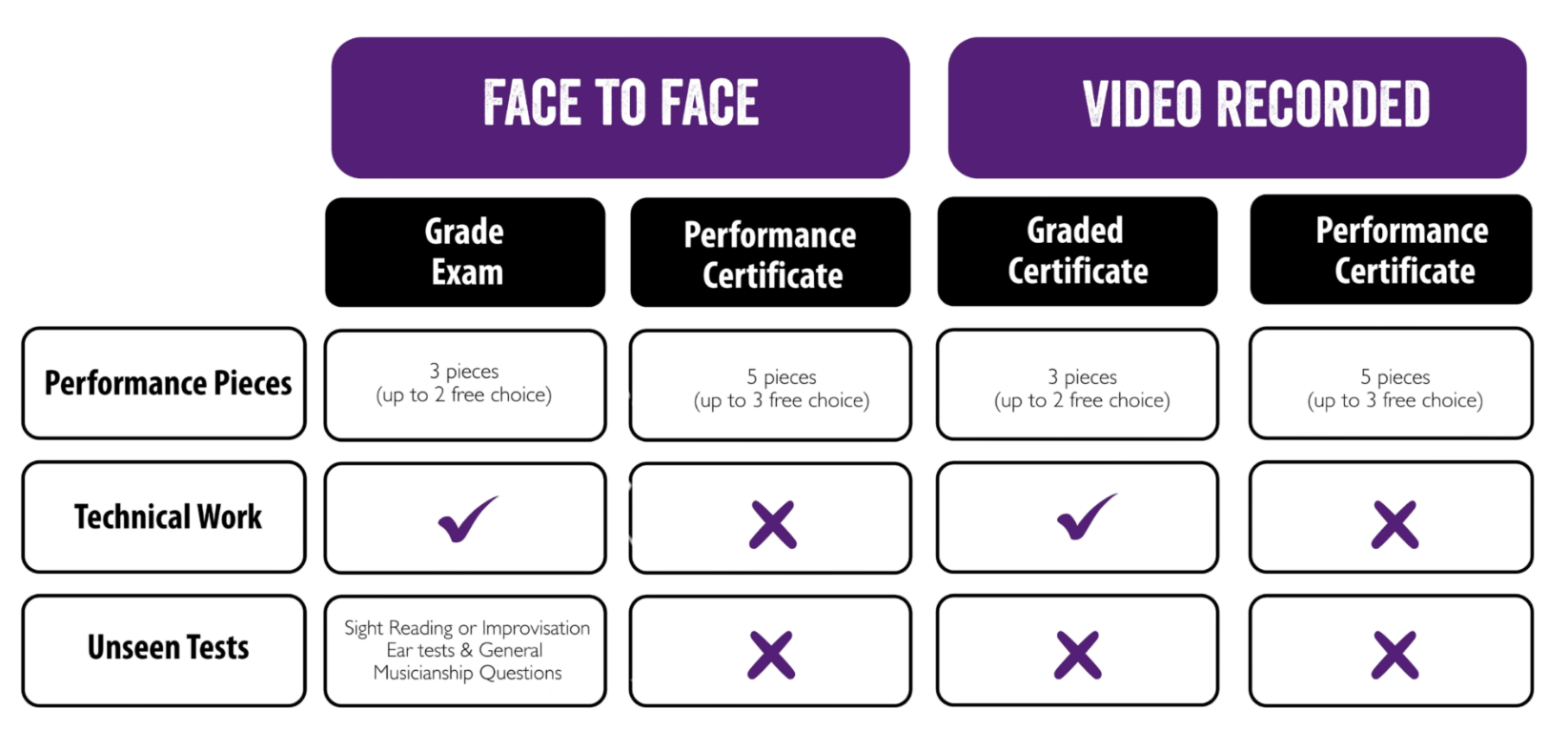
Grade Exam

Candidates perform 3 songs plus the technical work, ear tests, improvisation or sight-reading (Quick Study Pieces

from Grade 6) and general music questions.

Performance Certificate Exam

Candidates perform 5 songs only (no technical work, ear tests, improvisation or sight-reading or general music

questions required).

Video Graded Certificate Exam

Candidates perform 3 songs plus all the technical work. No ear tests or other unseen tests are required.

Video Performance Certificate Exam

This includes the same requirements as the face-to-face version.


Please note, there are different types of Performance Pieces, which are outlined on the AMEB Rockschool website.

AMEB has prepared some Rockschool exam tips relevant to both face-to-face and video options.

Video exams

Graded Certificate and Performance Certificate exams can be undertaken by video. Review the guides below:

Stageschool delivered by AMEB

Stageschool (by RSL Awards) offers practical syllabuses across a number of more contemporary performing arts areas. Their thoughtfully designed syllabuses and graded exams, ranging from beginner to advanced levels, provide clear benchmarks for progress. The assessments not only develop technical and artistic skills but also inspire creativity, resilience, and ignite a lifelong passion for the performing arts. AMEB SA & NT offers examinations in Stageschool’s Acting, Screen Acting and Public Speaking syllabuses.


  • Acting
  • Screen Acting
  • Public Speaking

Marks received Attainment level
85 and aboveDistinction
65-84Merit
50-64Pass
0-49  Unclassified

Stageschool practical

Premiere, then Grades 1 to 8

Level 3 Certificates (offered online) 


Level 4 and Level 6 Professional Diplomas in Performance and Teaching (offered online)

Exam typeFace-to-face examLive-streamed examVideo (pre-recorded) exam 
ActingYYY
Screen ActingNNY
Public SpeakingYYY (adapted content, refer to syllabus)